History/HRS 127 -- History of Christianity Since the Reformation
California State University,
Sacramento
Department of History and of Humanities/Religious Studies
College of Arts and Letters
Spring 2014
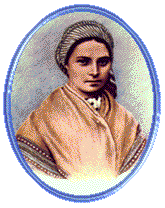
Bernadette of Soubirous
Catalog Description: HIST/HRS 127. European Christianity from the Reformation to the Present. Emphasis on the evolution of Christian thought, the co-existence of the Catholic and Protestant traditions, and the evolving relationship of religious and secular values in European culture. 3 units.
Course Description: This course has no formal prerequisites, although it is useful to have taken History 5 or Humanities 11.
The course is intended for HRS Religious Studies majors, for History majors interested in religious and the history of ideas, and for students from any major in the university interested in the history of Christianity and seeking an upper-division General Education course in the Arts and Humanities.
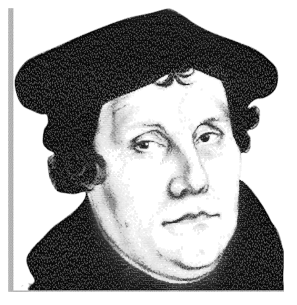
This course, which is a continuation of the Hist/HRS 126 taught by professor Nystrom, will give students a chronological survey of the main trends in European Christianity from Martin Luther to the present. It will focus on religious ideas (salvation through faith or through works), biography (Martin Luther, John Wesley, Pope Pius XII), on institutional history (from established religion to separation of church and state), and on religious sociology (demographic reasons for the success of Wesleyism).
Perhaps the course's main theme is the churches’ reactions to the secularization of western culture in the modern world: against the background of dechristianization, the Protestant response has been generally to accommodate modern culture, while the Catholic Church, despite some internal diversity, adopted a “fortress” and “triumphalist” mentality of authoritarian rejection of modern culture.
This course is meant for both believers and non-believers. On the one hand, the history of Christianity is very important for an understanding of western culture and history. On the other hand, believers may come to a deeper understanding of their faith by knowing its roots. The outcome of the course should be a renewed appreciation of the fundamental unity of all Christian peoples.
Class time is devoted to lecture and discussion of assigned reading material. Class attendance is very important.
The course requires three blue book tests each with a take-home essay.
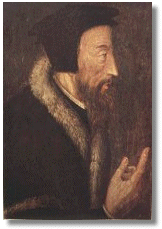
John Calvin Teaching
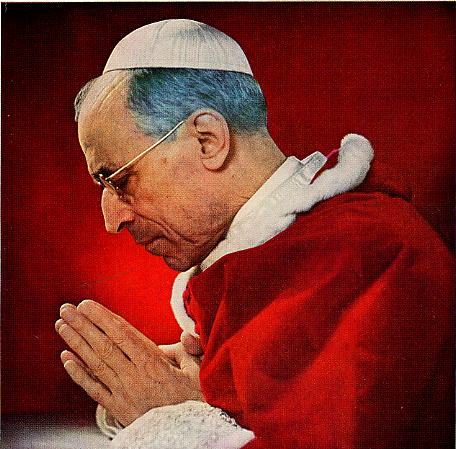
Pius XII in Prayer
Course Summaries
Course Materials - Mandatory
Part I
The Nicene Creed
John Colet and Erasmus
Life of Pope Alexander VI (Borgia)
Summary of Reformation Ideas
Scripture Readings for Studying Reformation
Luther at Worms from 'Luther'
John Calvin on Predestination
Calvin on the
Eucharist
Menno Simons - Wikipedia
Writings of Menno Simons
Analysis of the English Reformation
Church of England: the 39 Articles
Edward Campion, S.J.
The Jesuits: Ignatius of Loyola
Saints of the Cath olic Reformation
Decrees of the Council of Trent
The Council of Trent on Justification
Part II
Enlightenment Religion
Jefferson on Religion
Cartoons -- the Anglican Establishment
The Excellent James Woodforde
Study guide for Tompkins, 'Wesley'
Discussion Guide for Wesley
John Wesley Quotations
George
Whitefield's Rhetoric
Angers in 1785
Robespierre's speech on Supreme Being
The Concordat of 1801
Jules Ferry laws on free secular education
Separation of Church and state in France
Wikipedia on St. John Vianney
Wikipedia on St. Catherine Laboure
Wikipedia on St. Bernadette Soubirous
Wikipedia on St. Therese of Lisieux
Therese of Lisieux: "Story of a Soul'
Pius IX: 'The Syllabus of Errors' 1864
Pius IX: Decree on Papal Infallibility 1871
Part III
D&W: 19th Century Protestant Bilblical Criticism
Ernest Renan, "Vie de Jesus"
Adolf Harnack, 'Jesus' Essential Teaching'
'The Historical Jesus of Albert Schweitzer
Bultmann on Demythologizing
Early 20th Century Fundamentalism
Documents from Scopes Trial 1925
Documents of Vatican II
Blessed John Paul II
Europeans Fall Away from the Church
Excerpt from 'Rerum Novarum' 1891
Wikipedia on Liberation Theology
Wikipedia on Leonardo Boff
Boff on Liberation Theology
Boff later in Brazil
Rise of Evangelical Christianity in Brazil
Letter from Fr. Jack Donald (Honduras)
Study Questions for Exams
Short Essay Questions for Exam #1
Questions Exam #2
Questions Exam #3
Luther Essay
Wesley Essay
Pius XII Essay
Study Aids
Reading Guide for Marty
Tomkins on Wesley -- Reading Guide
Phayer -- Study Guide
Instructor: George S. Craft
More information is available on Dr. Craft's homepage. You may contact the instructor via e-mail at gcraft@csus.edu.