Hadrosaur Crests
Hadrosaurs (duck-billed donosaurs) had a variety of
large, hollow, bony structures on their heads (part of the skull).
The function of the crests is uncertain.
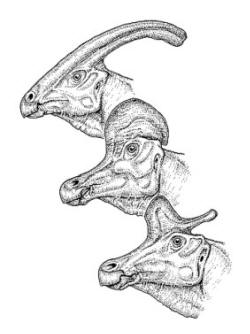
Construct three explanations for the crests
- one that invokes a survival strategy
- one that invokes a reproductive strategy
- one that is NOT due to natural selection
For each explanation, suggest a way to test your hypothesis.
Functions of head structures in different animals:
- Can you tell me why my cockatiel moves its crest up and down?
Content birds have their crests lowered. An alert bird raises
its crest vertically. Birds that are upset or frightened move
their crests straight up. (desibird.blogspot.com)
- The Pied Heron is a small, black-and-white heron of Northern
Australia. Older birds have a distinctive black crown and crest.
When breeding its crest plumes are longer.(Herons, Egrets and
Bitterns: Their Biology and Conservation in Australia by Neil
McKilligan)
- Antlers are one of the most easily recognized characteristics
of the family Cervidae. They are present only in males (with the
exception of caribou) and are capable of growing astoundingly
large. Their morphology varies among species. Males use their
full-grown antlers during the breeding season in social
interactions in competition for
females.(http://animaldiversity.ummz.umich.edu/site/topics/mammal_anatomy/horns_and_antlers.html)
- Rabbits' main cooling comes from their ears which act as
radiators. Their ears have the largest amount of thin fur and
exposed skin on their bodies. Pictures of Jackrabbits who live
in the prairie & desert show enormous
ears.(http://www.allearssac.org/differences.html)
- The Narwhal is unlike any other cetacean. The male has a long
spiraling tusk which is not normally possessed by the female.
The tusk which grows to a length of 1.5-3m (5-10ft) is actually
a modified tooth and looks like a twisted and gnarled walking
stick. During the 17th century the Narwhal tusk was thought to
have been the horn of the legendary unicorn. Studies suggest
that males engage in aggressive behavior when competing for
females. Scars attributed to tusk action have been found on the
heads of adult males which are more likely to have broken
tusks.(http://www.whales.org.au/discover/narwhal/narwg.html)