Here are some interesting and
useful
URLs (web addresses).
I will be adding to this list from time to time, so you may
want
to visit occasionally. If
you
find some valuable web resources
related to communication studies, please let me
know so I can
further develop this
resource.
Just click on the addresses or
the logo and you will go directly to the page you wish to review.
Page Topics:
Interactive
Instructional
Sites
Research
Tools
Writing Tools
Critical Tools
Interactive
Instructional Sites
Web Log: Explanation, Goals
and
Assignment
The web log or "blog" assignment helps
you
experience the blogging process. A blog is a kind of
online
journal or column about a specific topic or issue that
interests
you. The blog allows you to speak your mind to others
about what
you feel is important. In doing so, you present
yourself to the
world in particular ways that often merit some analysis
after you have
created a body of writing. To explore the assignment,
click on
the Blogger logo below.

Deep Poster: Model and Assignment
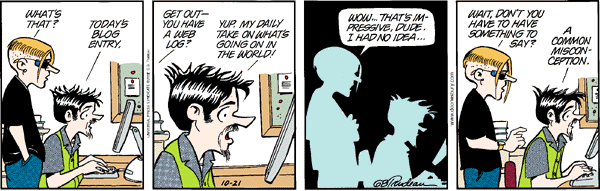
The "deep poster" is a tool for making
presentations of substantial content online. Using
both internal
and external
links,
well-designed deep posters
provide rich and dynamic information on a specific topic,
issue, or
concern. Click the cartoon below
to
see a model deep poster.

The Thirty Second Candidate
The Thirty Second Candidate is an interactive teaching unit
from
the Public Broadcasting System. It is a fascinating
tutorial in
how the 30 second spot came into existence, and how the
concept has
developed over time. The site allows you to "construct" a spot
of your
own. This site is worth visiting for insight into the
practice of
campaign message making.
http://www.pbs.org/30secondcandidate/timeline/
Research
Tools

This site provides a useful abstract
of
most popular internet search engines. You get a
quick and handy reference regarding
how
to structure the best searches using each.
http://www.notess.com/search/

Internet Detective: An interactive
tutorial
on evaluating the quality of Internet resources
Not everything on the internet is
necessarily
accurate or authoritative. If you are doing research
using the
web,
you must assess the material you find there--this is a job
you
typically
don't have to do using reference material in
a university library. I
recommend
you take a few minutes and work through the tutorials
here. This
site is
well designed and easy to use.
http://www.vtstutorials.ac.uk/detective/
Writing
Tools
APA (American Psychological
Association)
is
most commonly used to cite sources within the social sciences.
This
resource, revised according to the 6th edition of the
APA manual, offers examples for the general format of APA research
papers, in-text citations, endnotes/footnotes, and the reference
page.
http://owl.english.purdue.edu/owl/resource/560/01/
Critical
Tools

Index to and growing
database of
5000+ full text, audio and video (streaming) versions of public
speeches, sermons, legal proceedings, lectures, debates,
interviews,
other recorded media events, and a declaration or two.
http://www.americanrhetoric.com/

The aim of SIMILE is to provide a venue for scholarly
articles
which will bridge the subject areas of information literacy
and media
literacy.
The journal is wide-ranging in topics from analysis of popular
culture
(e.g.
Homer Simpson explains our postmodern identity crisis, whether we
like
it or not: Media literacy after "The Simpsons") to studies
in
instructional communication (Storied
lives, dialog - retro-reflections: Melding Critical Multicultural
Education
and Critical Race Theory for pedagogical transformation). This
is
an interesting journal of high quality research. Freely
available issues end with May 2009.