Support Page Content
Thursday, November 19th
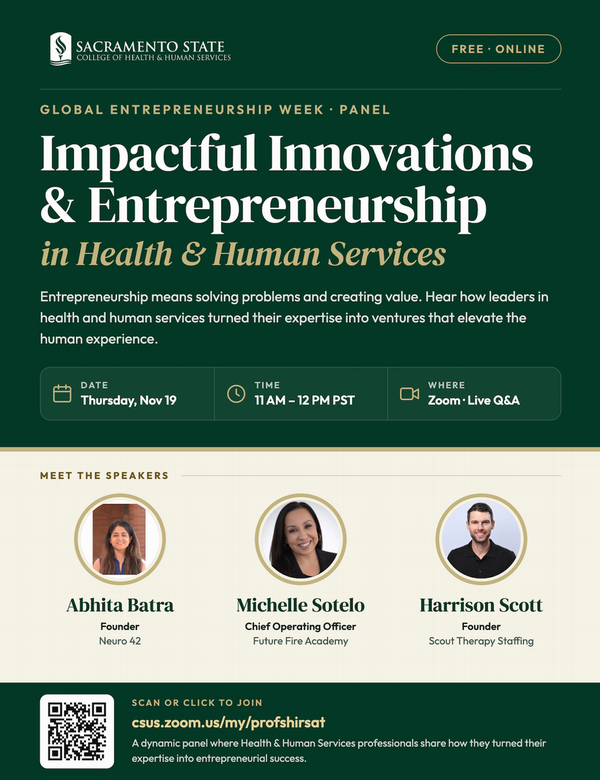
GEW- Impactful Innovations & Entrepreneurship in Health & Human Services
Entrepreneurship means solving problems and creating value. Here how leaders in health and human services turned their expertise into ventures that elevate the human experience.
Date: Tuesday, November 19, 2026
Time: 11 AM – 12 PM PST
Online via Zoom, followed by live Q & A
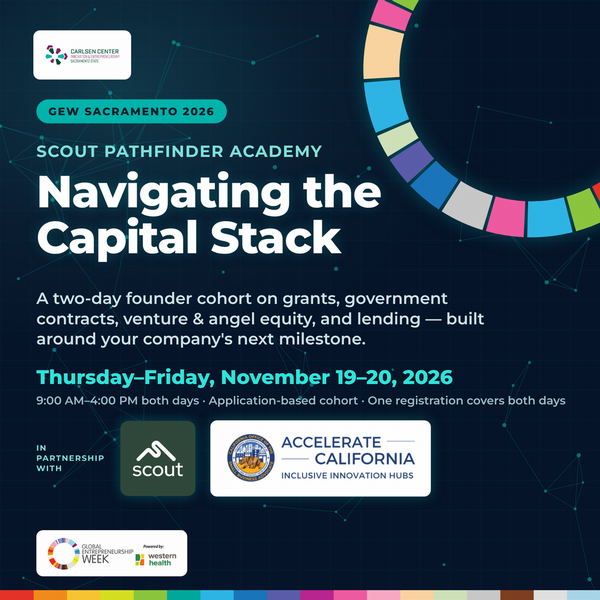
GEW 2026 - Scout Pathfinder Academy: Navigating the Capital Stack
Navigating the Capital Stack
Part of Global Entrepreneurship Week Sacramento · Powered by Western Health
Thursday–Friday, November 19–20, 2026 · 9:00 AM–4:00 PM both days
Hosted by the Carlsen Center for Innovation & Entrepreneurship, Sacramento State. Attendance format and location details will be confirmed with accepted companies. One registration covers both days.
Scout Pathfinder Academy builds from the original Pathfinder model: a founder cohort, expert instruction, hands-on work using Scout, and clear assignments that move each company toward an actual funding opportunity. The original program was centered on a five-week NSF SBIR application process. This cohort broadens the scope to help founders navigate the full capital stack: grants, government contracts, venture and angel equity, and lending. The goal is for each company to understand which sources fit its stage, what it needs to become ready, and how to sequence those sources around meaningful business milestones.
Format
Same cohort across both days; 9:00 a.m.–4:00 p.m.; short teaching blocks followed by exercises using each company's own materials. Initial cohort of 15–20 companies, subject to facilitation capacity and acceptance into the program.
Who should apply
Early-stage founders can participate, but each company should have a defined business concept and someone able to complete the work between sessions. Participants bring their pitch deck or company overview, a basic financial forecast, and any existing proposal materials. Registration is by application: the questions below capture company stage, product and market, traction/revenue, team, prior funding, existing debt, capital needed, use of funds, target milestones, and timing, and are used to assess readiness and tailor examples and working groups.
Day 1 — Thursday, November 19: Choose the Right Funding Strategy
9:00–9:30 · Opening and company readiness. Define the next business milestone, the capital needed to reach it, and the current funding gap. Output: one-page capital-needs brief.
9:30–10:15 · How the capital stack works. Compare grants, customer revenue from government contracts, equity, and debt by use of funds, timing, dilution, repayment, restrictions, and readiness. Work through a company example showing how different sources can support successive milestones. Output: initial funding-pathway map.
10:15–10:30 · Break.
10:30–11:30 · Grants: fit before writing. Translate a project into a fundable scope; assess eligibility, sponsor alignment, technical evidence, budget, and application effort. Use Scout to discover and assess relevant opportunities, with program availability and requirements checked against the live announcement. Output: qualified opportunity shortlist and a grant go/no-go assessment.
11:30–12:15 · Government contracts: winning a customer. Identify the buyer's problem, assess solicitation fit, evaluate prime versus subcontracting routes, and outline capability statements, past performance, pricing, registrations, and delivery capacity. Output: target-buyer profile and bid/no-bid checklist.
12:15–1:00 · Lunch.
1:00–2:00 · Equity raises: venture and angel readiness. Discuss when venture fits the business, investor expectations, market size, traction, round size, use of proceeds, and milestones for the next raise. Introduce SAFEs, priced rounds, dilution, and investor targeting through a simple worked example. Output: draft fundraising thesis and investor-fit criteria.
2:00–3:00 · Lending: readiness and repayment. Compare term loans, lines of credit, SBA-backed and community lending, equipment financing, and venture debt at a conceptual level. Examine cash flow, repayment capacity, collateral, guarantees, covenants, and the risk of borrowing against uncertain future awards or investment. Output: borrowing-needs and repayment worksheet, including a "not ready for debt" option.
3:00–3:15 · Break.
3:15–4:00 · Build the company's funding roadmap. Prioritize a primary and secondary pathway; identify prerequisites, timing, owners, and dependencies. Output: first draft of a 90-day action plan and a 12-month capital roadmap.
Between sessions: Demonstrate progress
Each company validates its funding assumptions, updates its forecast, researches priority targets, and prepares one substantive draft for its primary pathway: a grant concept and budget; a capability statement and contract capture brief; an investor deck and target list; or a lender package outline and cash-flow forecast. Everyone also documents what changed in their capital roadmap.
Day 2 — Friday, November 20: Build, Review, and Execute
9:00–9:30 · Progress review. Share completed work, new evidence, and blockers. Output: revised funding priorities.
9:30–10:15 · One company, different funding narratives. Adapt the same evidence for a grant reviewer, government buyer, venture investor, and lender. Output: concise, audience-specific funding asks.
10:15–10:30 · Break.
10:30–11:30 · Grant and contract execution lab. Turn requirements into a response outline, milestones, budget or pricing, supporting-document checklist, and review schedule. Demonstrate Scout-supported drafting with founder verification of facts and requirements. Output: improved grant concept or contract response plan.
11:30–12:15 · Venture execution lab. Review pitch structure, traction evidence, fundraising milestones, investor outreach, data-room preparation, and a sample dilution scenario. Practice a concise pitch and investor questions. Output: revised pitch outline, prioritized investor list, and outreach draft.
12:15–1:00 · Lunch.
1:00–1:45 · Lending execution lab. Review financial statements, cash-flow forecasts, use of proceeds, existing obligations, and common underwriting questions. Stress-test a sample repayment plan under delayed revenue. Output: lender-readiness checklist and revised financing request.
1:45–2:45 · Pathway working groups. Companies concentrate on their primary pathway and receive structured peer and facilitator feedback. Output: one reviewed funding asset and a specific list of remaining gaps.
2:45–3:00 · Break.
3:00–4:00 · Funding roadmap presentations and next steps. Each company presents its capital need, preferred sources, evidence of fit, and next actions. Output: final 90-day plan, 12-month capital roadmap, and a readiness assessment for follow-on support.
What participants leave with
A company-specific capital strategy, a prioritized funding pipeline, one reviewed funding asset, a checklist of missing materials, and an action plan with owners and dates. Progress is measured through readiness and completed work; actual submissions and funding outcomes will depend on opportunity timing and each company's circumstances.
Companies that attend both days, complete the assignments, and demonstrate a credible funding pathway may be invited to an optional execution cohort in January, with scope and resourcing agreed separately.
Presented by
The Carlsen Center for Innovation & Entrepreneurship at Sacramento State with Scout, which leads the platform and grant-development components; contract, venture, and lending expertise is added where needed. This program is offered as part of the Accelerate California Innovation Hub, a program funded by the California Office of the Small Business Advocate (CalOSBA).
Accessibility: If you need any accommodations, please let us know at least two weeks in advance so we can arrange them.
Global Entrepreneurship Week (GEW)
The 2026 theme is “Entrepreneurs Thrive Here.” The Global Entrepreneurship Network announced that 11,000 partner organizations across 200 countries will declare this message in November. The campaign aims to show people that entrepreneurship is a path open to them in their own communities. It is aimed especially at people who face structural barriers or may never have considered launching a startup. It connects them to the networks, tools, and support to take a first step.
