Support Page Content
Delegation of Fiscal Authority
Purpose
Delegation of Fiscal Authority, also referred to as Delegation of Authority or DOA, is the formal assignment of authority to review and approve financial transactions on behalf of Sacramento State.
Delegation establishes accountability, supports appropriate internal controls, and helps ensure that University funds are used:
- For legitimate University business purposes
- In support of the University’s mission and priorities
- Within approved budgets
- In accordance with applicable CSU and Sacramento State policies
- In compliance with restrictions associated with the funding source
Fiscal authority is assigned to an individual based on the person’s organizational role, responsibilities, and authorized Department ID, fund, or project. Delegated authority may not be transferred informally to another employee.
Delegation of authority does not eliminate the responsibility of employees who initiate, prepare, review, or process a transaction. Everyone participating in a financial transaction is responsible for the accuracy, appropriateness, and completeness of the information within their area of responsibility.
The CSU’s systemwide requirements are established through the Fiscal Authority and Responsibility policy.
Delegated Approver Responsibilities
- Review the business purpose and documentation: Confirm that the expense is reasonable, supports University business, and includes complete and accurate documentation.
- Confirm the funding source and chartfields: Verify that the appropriate funding source and campus chartfields are used.
- Verify funding availability: Ensure sufficient funds are available. For multi-year commitments, confirm that funding can be sustained for the full term.
- Confirm the expense is allowable: Verify that the funding source may be used for the expense, including compliance with student fee restrictions and applicable CSU and campus policies.
What is DOA 360 and Why is it Important?
DOA 360, is the CSU’s centralized system for maintaining fiscal approval assignments within the Common Financial System (CFS). At Sacramento State, it identifies employees authorized to approve financial transactions for designated departments, funds, or projects. DOA 360 supplies approver information to systems such as Concur and CSUBuy, helping transactions route to the appropriate approver based on the assigned authority and approval level.
DOA 360 records:
- Who is authorized to approve financial transactions
- The Department ID, fund, or project covered by the authority
- The applicable financial function, including:
- JGS: CSUBuy goods and services
- TR: Concur travel requests
- TE: Concur travel expense reports
- BT: Budget transfers
- ET: Expenditure transfers
- The approver’s assigned authority level and spending limit
- The approval hierarchy used to route transactions
How Transaction Routing Works
When a transaction is submitted through Concur or CSUBuy, the system uses the applicable chartfield information and transaction amount to identify an authorized approver in DOA 360.
- Concur uses DOA 360 assignments to route fiscal DOA approvals for travel requests and travel expense reports.
- CSUBuy uses DOA 360 assignments to route requisitions for goods and services.
If an appropriate DOA assignment is not available, the transaction may not route correctly and could be delayed.
Why DOA 360 Is Important
DOA 360 provides an electronic record of the University’s fiscal delegations and supports consistent approval routing across financial systems. In practical terms, it identifies:
- Who may approve a transaction
- What types of transactions they may approve
- Which departments, funds, or projects their authority covers
- The maximum amount they are authorized to approve
This helps ensure that financial transactions receive appropriate review and are approved in accordance with CSU policy and campus requirements.
DOA Level Definitions and Titles
All approval levels (1–5) may submit a requisition in CSUBuy, CFS, and Concur, provided they have access to the respective system. However, regardless of an individual’s approval authority, any request submitted must be approved by someone with a higher approval level than the requestor (One-Up Approval). Individuals who have DOA are not allowed to approve their own requests.
| Level | Level Definition | Roles/Titles | Approval Authority Limits |
|---|---|---|---|
| 1 | Individual with oversight of campus and auxiliaries | CFO/President | $5,000,001+ by Dept ID(s) and X fund |
| 2 | Individuals with oversight of divisions or auxiliaries | CFO, Provost, Vice President, Executive Director of University Auxiliary Organization, Campus-Wide Fiscal Officers (Limited to Budget Planning and Administration and Financial Services) | CSUBUY-$500,001 – $5,000,000, by Dept ID(s) and X fund |
| 3 | Individuals with oversight of sub-divisions or colleges | Deans, Associate Vice Presidents, Athletic Director, Vice Provosts | CSUBUY-$100,001 – $500,000 by Dept ID(s) and X fund |
| 4 | Individuals with delegated authority to spend from and manage approved budgets | Management Personnel (MPP) or Academic Equivalent, Department Chairs, Faculty Directors, Associate Deans, Directors | CSUBUY-$5,001 – $100,000 by Dept ID(s) and X fund |
| 5 | Individuals who process, monitor and execute expenditures transaction on behalf of higher authority | Non-MPP, Fiscal Analysts or Administrative Support personnel (CRA, ASC’s, Budget Analysts) | CSUBUY-Up to $5,000 by Dept ID(s) and X fund |
| Faculty, Lecturer | None (zero) |
Types of Fiscal Transactions
CSUBuy: Goods and Services (JGS)
Purchases such as equipment, software, subscriptions, supplies, hospitality, consultants, independent contractors, and other services.
Concur: Travel (TE, TR)
Travel requests and expense reports, including transportation, lodging, registration, meals, and mileage. TE and TR also cover ProCard transactions which are allowable, generally low-dollar purchases made with a University Procurement Card in accordance with applicable procedures.
Concur: ProCard Transactions (PC)
Allowable, generally low-dollar purchases made with a University Procurement Card in accordance with applicable procedures.
Expenditure Transfers (ET)
Requests to move an expense from one chartfield or funding source to another.
Budget Transfers (BT)
Requests to move budget authority between approved chartfields or funding sources.
How to Request DOA
Only designated individuals may submit a Common Access Request System (CARS) form to establish or modify Delegation of Authority (DOA). Each request must be reviewed and approved by an authorized campus budget official, such as a division budget director, associate dean, dean, or vice president. To request DOA or discuss whether it is appropriate for your role, please contact the appropriate representative listed in the table below.
| DOA CARS Requestor | Department | Division | DOA CARS Request Primary Approver |
|---|---|---|---|
| Katrina Roose | College of Business | Academic Affairs | College Associate Dean |
| Arlene Alforque-Hernandez | College of Continuing Education | Academic Affairs | College Associate Dean |
| Cynthia LaFitte | College of Continuing Education | Academic Affairs | College Associate Dean |
| Petronilla Nyamayaro-Emiru | College of E&CS | Academic Affairs | College Associate Dean |
| Suzanne Abshire | College of E&CS | Academic Affairs | College Associate Dean |
| Maria Isabel Ibarra | College of Education | Academic Affairs | College Associate Dean |
| David Gleason | College of H&HS | Academic Affairs | College Associate Dean |
| Ingrid Kantola | College of H&HS/ VP's Office - Acad Affairs | Academic Affairs | College Associate Dean |
| Laura Emerson | College of NS&M | Academic Affairs | College Associate Dean |
| Michelle Williams | College of NS&M | Academic Affairs | College Associate Dean |
| Aaron Eichenberger | College of SS&IS | Academic Affairs | College Associate Dean |
| Marsha Robinson | College of SS&IS | Academic Affairs | College Associate Dean |
| Robyn Pitts | College of SS&IS | Academic Affairs | College Associate Dean |
| Chaia Lee | Arts and Letters | Academic Affairs | College Associate Dean |
| Maria Ramirez | Library | Academic Affairs | College Associate Dean |
| Stacie Jensen | Library | Academic Affairs | College Associate Dean |
| Leigh Barber | Provost's Office | Academic Affairs | Assistant Vice President for Academic Administration |
| Kimberley Smith | Undergraduate Studies | Academic Affairs | Undergradutate Dean |
| Kat Hughes | VP's Office - Academic Affairs | Academic Affairs | Assistant Vice President for Academic Administration |
| Kendall Newman | Budget Planning and Administration | Administration and Business Affairs | — |
| Jeanne Brewster | Financial Services | Administration and Business Affairs | Chief of Operations |
| Cody Bright | Admissions | Division of the President | Deputy Chief of Staff |
| Tasheena Bettencourt | Athletics | Division of the President | Associate Athletic Director for Business Operations |
| Karina Garcia-Solorio | Enrollment Management | Division of the President | Deputy Chief of Staff |
| Rheena Munoz | Enrollment Management | Division of the President | Deputy Chief of Staff |
| Nicholas Hodge | Presidential Executive Operations | Division of the President | Deputy Chief of Staff |
| Nikki Khamsouksay | Presidential Executive Operations | Division of the President | Deputy Chief of Staff |
| Candace Bridge | Registrar | Division of the President | Deputy Chief of Staff |
| Alexandra Owens | Inclusive Excellence | Inclusive Excellence | Director of Shared Business Resources |
| Jesseca Sanchez | VP's Office - Information Resources and Technology | Information Resources and Technology | Vice President of Information Resources and Technology |
| Michele Veseley | VP's Office - Information Resources and Technology | Information Resources and Technology | Vice President of Information Resources and Technology |
| Jagan Pandarinathan | Information Security | Information Resources and Technology | Vice President of Information Resources and Technology |
| Deborah Ceryes | VP's Office - People and Climate | People and Climate | Vice President of People and Climate |
| Amy Brown | Student Affairs Business Resources | Student Affairs and Inclusive Excellence | Director of Shared Business Resources |
| Angela Arnold | Student Affairs Business Resources | Student Affairs and Inclusive Excellence | Director of Shared Business Resources |
| Anne Cheng | Student Affairs Business Resources | Student Affairs and Inclusive Excellence | Director of Shared Business Resources |
| Jeffrey Pantoja | Student Affairs Business Resources | Student Affairs and Inclusive Excellence | Sr. Vice President for Student Affairs and Inclusive Excellence |
| Shannon Ainger | Student Affairs Business Resources | Student Affairs and Inclusive Excellence | Director of Shared Business Resources |
| Sharon Hopkins-Bright | Student Affairs Business Resources | Student Affairs and Inclusive Excellence | Director of Shared Business Resources |
| Tatiana Azad | VP's Office - University Advancement | University Advancement | Vice President of Unversity Advancement |
Frequently Asked Questions
The CO created a reporting dashboard in Financial Data Warehouse (FDW). Drill down by Business Unit, DeptID, Fund, Dapartment Tree, even look up a specific employee.
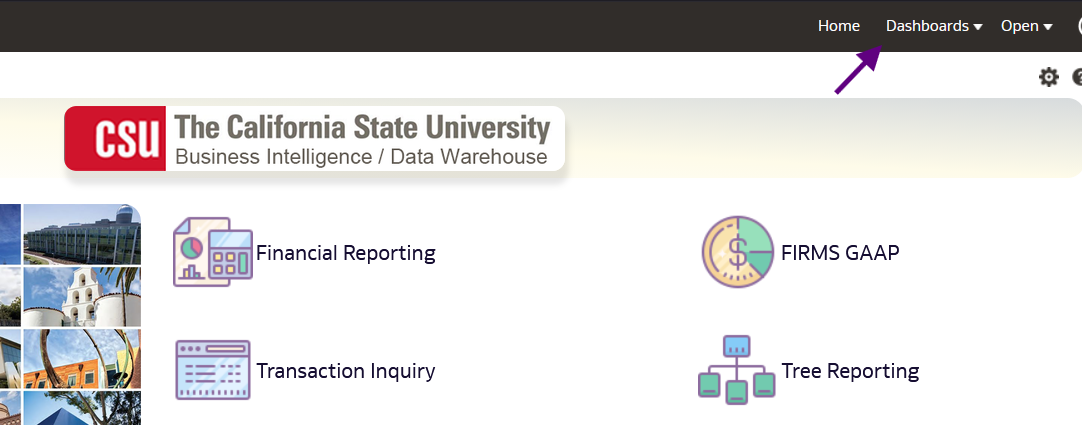
This is the main FDW landing page. Int the upper right there is a dropdown menu named Dashboards.
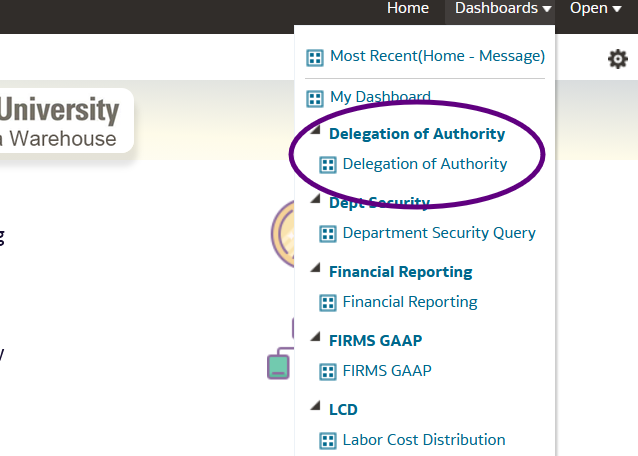
Clicking on the Dashboards menu gives you a list of other reports and views available, including Delegation of Authority.
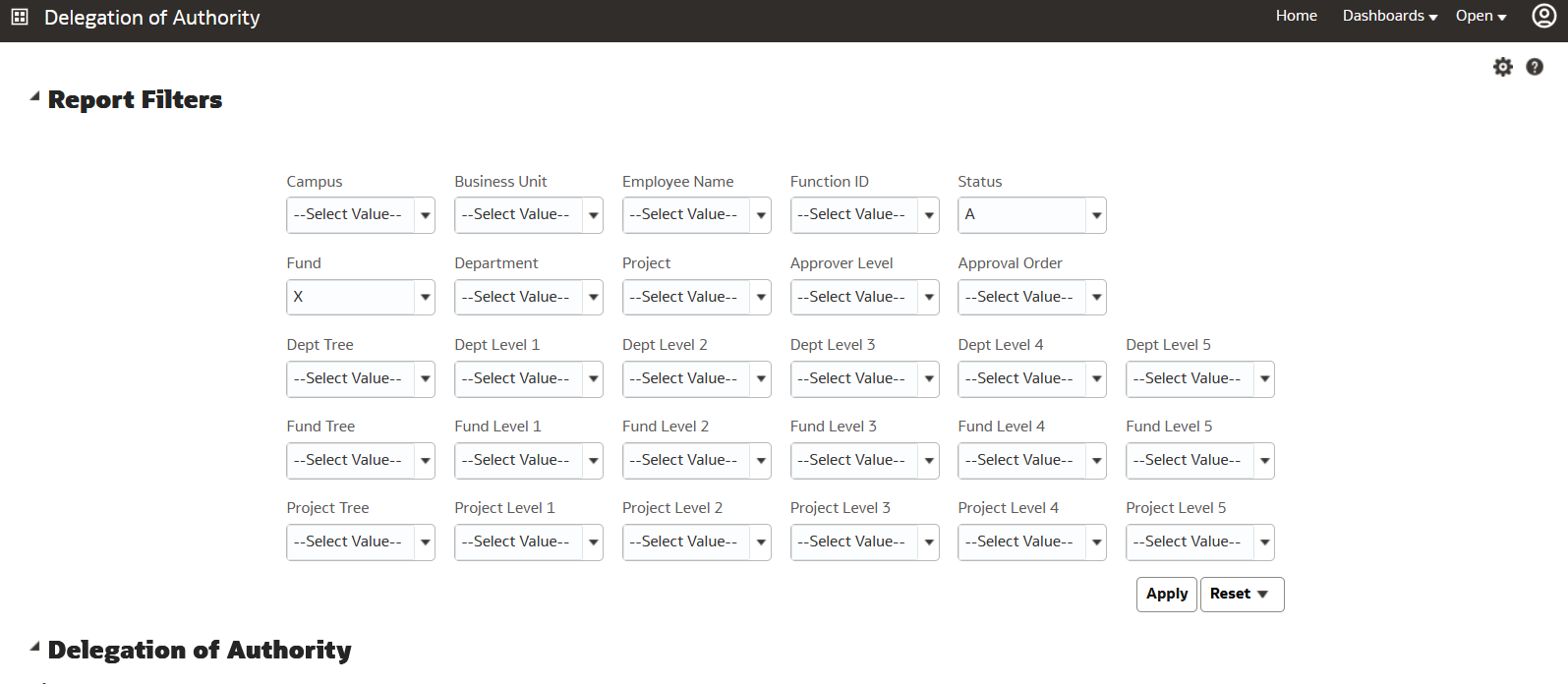
Clicking on the Delegation of Authority option in the Dashboards dropdown brings you to the familiar FDW Filters. Drill down by Business Unit, Department ID, even by a specific person.
Things to keep in mind:
- You will need to populate the Campus
- You will need to populate the Business Unit
- Less is often more in FDW.
- Review the Business Purpose and Documentation
Confirm that the purpose and justification for the expense are clear, reasonable, and related to University business. Ensure all required supporting documentation is complete and accurate. - Confirm the Funding Source and Chartfields
Verify that the transaction is charged to the appropriate funding source and campus chartfields to support accurate accounting and financial reporting. - Verify Funding Availability and Sustainability
Ensure sufficient funds are available to cover the expense. For multi-year commitments, confirm that the funding plan is reasonable and sustainable for the full term of the commitment. - Confirm Allowability and Policy Compliance
Determine whether the proposed expense is an allowable use of the selected funding source, including any restrictions associated with student fee revenue. Ensure compliance with all applicable CSU and campus policies and procedures.
- Reminder that even the lowest DOA level must have budget approval authority from their VP’s office.
- DOA levels are part of employment position and classification codes. Level 4 must be MPP or Academic Equivalent and Level 5 can be non-MPP employees. Employees taking on DOA roles do also take on the equivalent financial risk and should be aware and prepared for the individual risks.
- Position Levels and Approval Levels Should Align.
- If you are an Analyst, your approval level should be 5.
- If you are an AVP your approval level can be up to level 3.
- Divisions can decide to make the levels more strict, but they cannot give a person in a level 5 position higher than level 5 approver ability.
- Position Levels and Approval Levels Should Align.
- DOA amounts were updated by a CSU wide Policy.
Please contact the campus DOA 360 Adminstrators if you have any questions.
Yavette Hayward: haywardy@csus.edu
Margaret Hwang: mh227@csus.edu