Story Content
Student innovators build robotic arm and web app aimed to teach American Sign Language to children, families
March 13, 2026
A note to readers: This story does not necessarily reflect the perspectives of all members of the Deaf community on the use of AI or robotic tools to teach American Sign Language to deaf or hard of hearing children and families.
This story highlights a student innovation and does not include perspectives from Deaf community members or ASL experts. We recognize the importance of including Deaf voices when discussing technologies related to ASL and Deaf communities, particularly given the history of such efforts being developed without community input.
Salma Waleed Aboukhadra grew up building Lego robots for school competitions, and anytime an electronic device broke, she’d “completely tear it apart.”
“I had to understand why it stopped working. But I wouldn’t ever put it back together,” she said with a laugh.
Aboukhadra and fellow Computer Engineering student Edgar Sandoval share a love of robots and tackling problems.
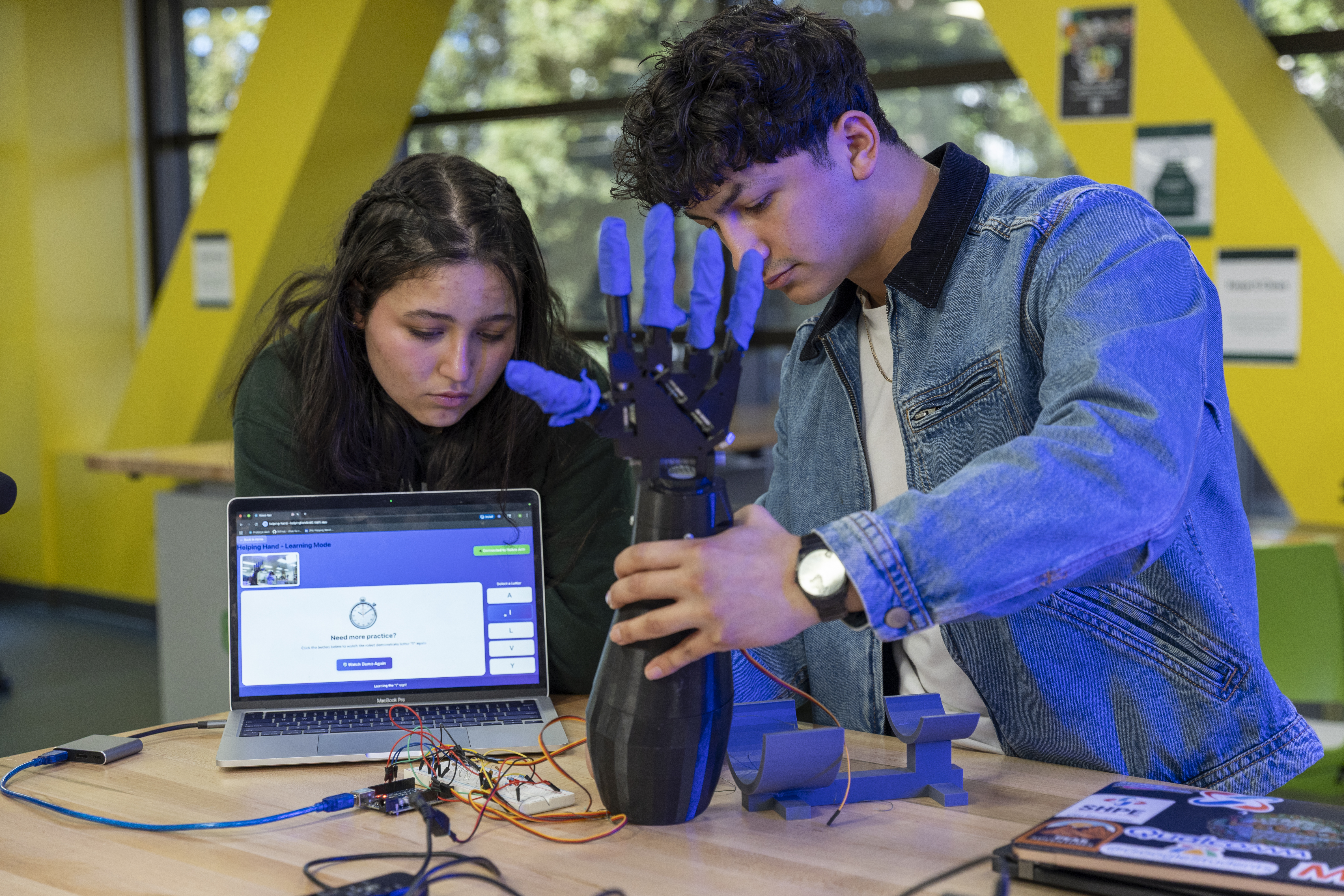
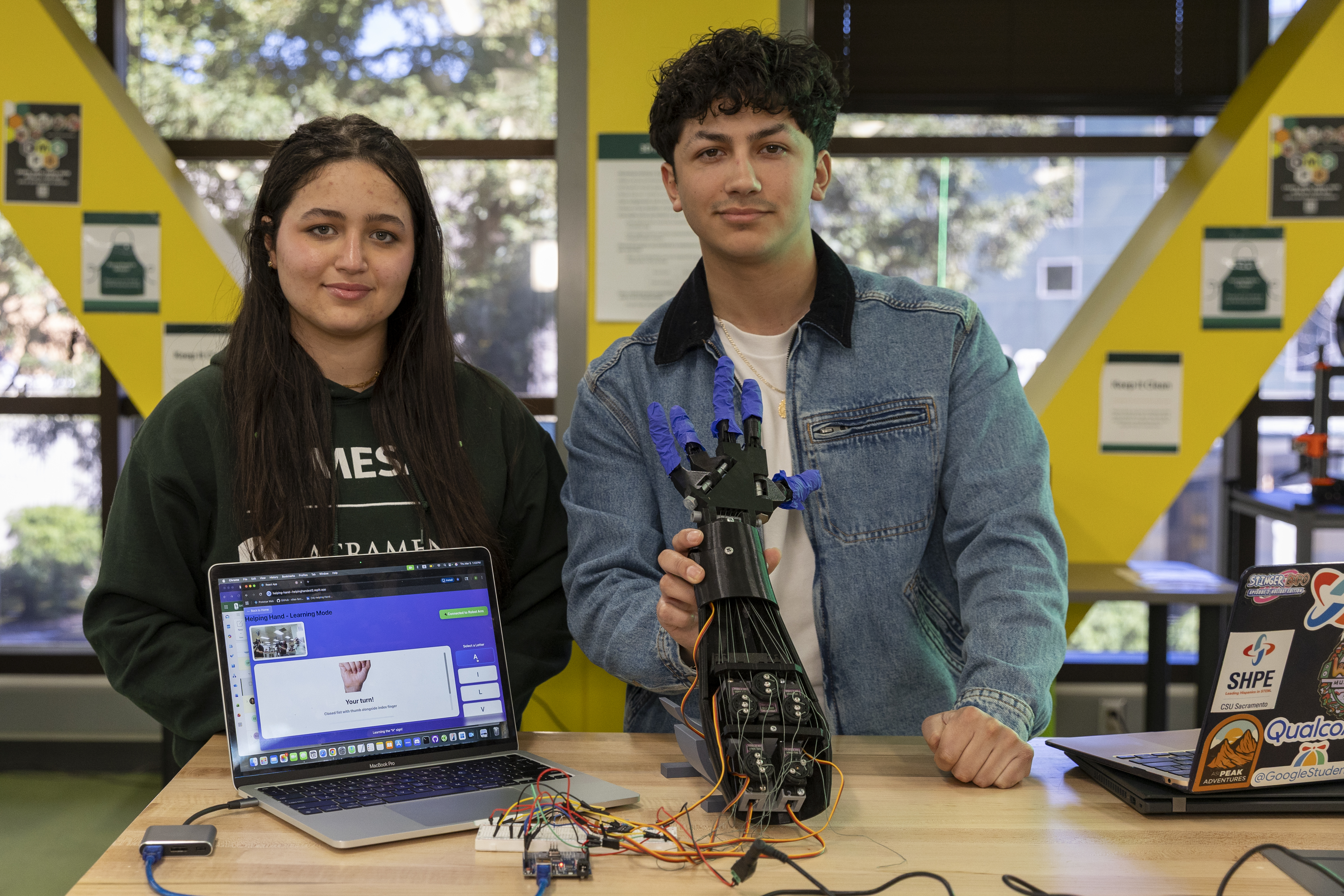
Together they built a low-cost robotic arm and an AI-powered web app called Helping Hand to support deaf and hard-of-hearing children and their families as they learn American Sign Language.
Aboukhadra and Sandoval, along with teammates Elias Farzdad, Olei Amelie Ngan, and Vaibhavi Naik, were among the six Sac State-affiliated teams who participated in this year’s Sacramento Kings Capitalize Next Gen Startup Competition, including:
- Data Pigeon - an AI-driven predictive maintenance platform for EV charging infrastructure that detects failures before they impact drivers
- DipDetect - a rapid, low-cost allergen detection test strip designed for real-time use in food and beverages
- GuLP - an AI-powered platform designed for autistic users who process language in whole phrases
- RxMinder - a medication management platform that combines AI-verified tracking with human oversight to reduce medication errors and improve compliance
- SentrySight - an AI-powered security platform that enables real-time firearm detection using existing camera infrastructure, transforming surveillance from reactive recording to proactive threat prevention
Helping Hand provides real-time, three-dimensional feedback to support learning for select ASL handshapes and gestures, but not the full language. ASL is a visual language that uses shape, placement, movement of the hands as well as facial expressions and body movements to communicate and convey information.
Perspectives on the role of technology in ASL learning vary within Deaf communities, particularly regarding tools developed without direct community input.
Sandoval got the idea for an ASL robotic arm when he was a cashier at a fast-food chain.
“A family came in and tried to communicate with me through American Sign Language. I didn’t know what they were trying to say,” Sandoval said. “I didn’t know what they wanted, and I was embarrassed that I couldn’t interact with them or make my customers happy.”
The memory stayed with Sandoval.
“It’s rooted in the ethos of Sac State to try and solve a tough problem ... I’m just really excited and proud of all the work they’ve put in, especially since they’re doing this outside of their classroom time.” -- Carlsen Center for Innovation and Entrepreneurship Executive Director Cameron Law
“I’d always wanted to build a robotic arm, but I never knew what it was going to do,” he said. “Then I was like, ‘What if it teaches American Sign Language?’ It could be more interactive rather than looking at a two-dimensional computer screen.”
Sandoval’s idea was to build a robotic hand that would demonstrate select ASL hand movements associated with letters or words that a user types into an app. In addition to parents and families, Helping Hand could potentially be used in classrooms as a supplemental tool to reinforce teachers’ lessons.
But last fall, when he tried to get other students on board for Hornet Hacks, Carlsen Center’s three-day hackathon, Sandoval had trouble finding takers.
“One person told me it’s not ‘doable.’ But I was like, ‘You’re not thinking big enough,’” he said. “So I went to Salma, because I knew she was interested in programming and working in robotics. And she was a hundred percent down to try it out.”
Using 3D printers in the StingerStudio Makerspace, they designed and built a robotic arm and developed a web-based app.
At the end of the long weekend, Helping Hand took first place in the overall and wildcard categories.
In November, Aboukhadra and Sandoval went on to compete and win the STEM Pitch Competition for College of Engineering and Computer Science students. Since then, they’ve applied to enter the Big Bang! Business Competition at UC Davis and the nationwide e-Fest in Minneapolis.
The Helping Hand team also participated in the Carlsen Center’s Innovation Lab, where they worked with Executive Director Cameron Law to develop the business side of their idea.
“I worked with them to dive further into understanding how they could bring this business into fruition,” Law said. “A lot of our work is less on the tech side and more about helping them understand the marketplace and how to get in front of the customers.
“The major risk in any business is whether there are paying customers on the other side. We helped them navigate through that, and helped them understand who will actually be purchasing their product. Even though teachers and students will be using the product, it’s usually the administrator who will be purchasing it.”
The team also assured educators that their product was not meant to replace teachers or tutors, but serve as a tool to support student learning.
Law guided them on marketplace research.
About 90 percent of hard-of-hearing children are born to parents who do not speak ASL, creating a language barrier. In addition, some 70 percent of families don’t have the resources to learn ASL. Many ASL learning programs and private tutors are too expensive for families, further widening the communication gap between parents and children.
Families access ASL through a range of approaches, including community-based programs, schools for the Deaf, and direct engagement with Deaf educators.
“They’ve been doing the research to come up with numbers,” Law said. “But they’ve also been doing true market research, going out there and talking to potential customers and seeing how they would use it, so they can take that feedback to help them iterate the product from there.”
They hope to eventually build a second robotic arm and body to incorporate the full visual language.
Sac State dominated this year’s Kings Capitalize competition with Hornets on six of the top eight teams vying to be in the final four.
Data Pigeon and GuLP advanced to the Top 4. Fans can vote online to choose the winner of the $10,000 cash prize, which will be announced during halftime of the Sacramento Kings game on April 3.
“It speaks to our talented students,” Law said. “They’re tackling these really tough problems and applying technology to them …
“It’s rooted in the ethos of Sac State to try and solve a tough problem, and these students have a willingness to lean in and explore that. I’m just really excited and proud of all the work they’ve put in, especially since they’re doing this outside of their classroom time.”
Media Resources
Faculty/Staff Resources
Looking for a Faculty Expert?
Contact University Communications
(916) 217-8366
communications@csus.edu