CSUS Courses
EDS 239, Educational Specialist (Ed.S.) Seminar
Explores leadership roles of school psychologists. Click here for course materials.
EDS 240, Functional Assessment of Behavior
Assessment of behaviors using the techniques of applied behavior analysis. Students will learn how to conduct functional assessments of behavior and how to write behavior intervention plans. Methods appropriate for assessment of children in the school setting will be emphasized. Click here for course materials.
EDS 243, Assessment Practicum
Administration, scoring, and interpretation of tests taught in EDS 242A-B, EDS 244, or EDS 247. Students will be assigned five to seven cases. They will assess the children, meet with the families to gather history, and render interpretation. Click here for course materials.
EDS 244, Social, Emotional, and Behavioral Assessent
Examines social/emotional assessment strategies and instruments appropriate for working with students in schools. Topics incllude clinical interviewing, social-emotional functioning, and effective report writing. Click here for course materials.
EDS 245, Psychology in the Schools
Overview of psychology in the schools. Topics include school systems, program development, service delivery models and the role of the school psychologist. Students will engage in systematic school observations. Click here for course materials. Click here for course materials.
EDS 246B, Preventive Mental Health Interventions
Study and application of various primary, secondary, and tertiary psychological interventions designed to prevent school failure and/or emotional challenges. Examines techniques of identifying pupils who are experiencing mental health difficulties that interfere with school functioning, and intervention techniques designed to address these problems. Click here for course materials.
EDS 247, Assessment of Special Needs
Assessment of Special Needs. Assessment of client behavior using formal and non-formal methods based on neuropsychological principles. Students will learn to use interview techniques, standardized cognitive and projective tests, and neuropsychological screening procedures to assess students with special needs. Report writing, parent conferences, and consultation strategies will be stressed. Typically taken concurrently with EDS 243. Assessment Practicum. Click here for course materials.
EDS 248, Human Development and Learning
Cognitive, socioemotional and personality development through the life span (with emphasis on birth through early adulthood) as influences on the learning process. Includes analysis of theories, empirical research and current issues in human development and learning as applied to school learning. Click here for course materials.
EDS 249, Special Seminar: School Psychology
Individual projects or directed reading. Click here for course materials.
EDC/EDGR 250, Education Research
Studies qualitative and quantitative methods in the development of reliable knowledge in the field of education. Includes identification and formulation of research problems, research designs and presentation of reports representative of different research strategies. Classified students are encouraged to take this course early in their graduation programs. Click here for course materials.
EDS 540/541/542, Master's Project, Ed.S. Thesis/Project: Education/School Psychology.
Credit given upon successful completion of a thesis/project approved for the Master of Arts in Education/School Psychology. Click here for course materials.

Workshop Presentations
California Association of School Psychologists
- Understanding Adolescent Depression: Consulting with Parents (To, Novakovskiy, Anderson, Yu, & Brock; March 2009)
- Treatments and Interventions for Youth with Bipolar Disorder (Hart & Brock, March 2009)
- The Manifestations and Symptoms of, and Recommendations for, Students with PTSD (Rodriguez & Brock, March 2009)
- Suicide Postvention: Suggested Procedures During the Aftermath of a Student Suicide (Martinez & Brock, March 2009)
- California State University, Sacramento, Student Presentation (March 2009)
- Change Your Focus! Solution-Focused Brief Therapy in the Classroom (Dubitsky, Macias, & Quintero)
- Identifying Intellectual Disability: Guidance for the School Psychologists (Brock & Dipad, October 2012)
- Suicide Prevention, Intervention, and Postvention (Smith, Courtright, & Brock, October 2012)
- Social Media and Crisis Prevention and Intervention (Magnesi, Flitsch,& Brock, October 2012)
- California State University, Sacramento, Student Presentations (November 2013)
- Responding to Student Suicide: Effective School Suicide Postvention (Larkin, Bryan, & Brock)
- Academic Demands and Youth Social-Emotional Health: New Directions (Holland & Sisson)
- Middle School early Intervention Group Therapy Curriculum: Teaching Tolerance (Larkin, Sisson, Judy, and Holland)
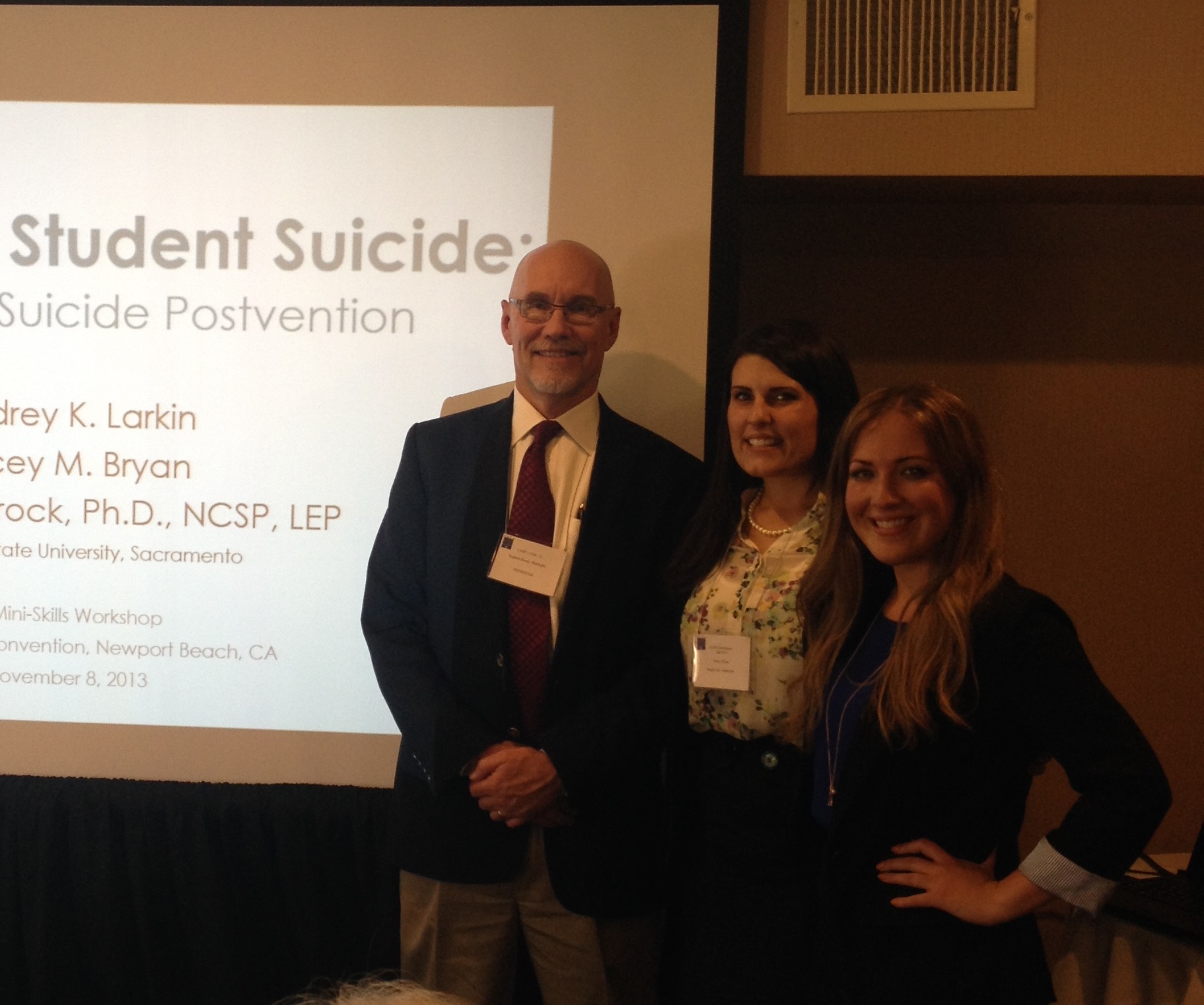
Student presentations at CASP 2013 (Dr. Brock, with Lacey Bryan and Audrey Larkin)

CSUS faculty and student presenters at CASP 2013
Hillary Sisson, Dr. Holland, Dr. Brock, Lacey Bryan and Audrey Larkin (missing Jennifer Judy)
National Association of School Psychologists
- The School Psychologist's Role in the Identification of Autism (February 2009)
- Assessing and Intervening with Children Exhibiting PTSD in the School Setting , Psychological Trauma Checklist, Traumatic Stress Screening Measures, PTSD Diagnostic Evaluation Backgroud Questionnaire (February 2009)
- Cross-Cultural and Cross-National Considerations in Crisis Intervention (March 2010)
- Crisis Intervention and Recovery: The Roles of the School-Based Mental Health Professional (February 2011)
- Assessment, Identification, and Treatment of Autism Spectrum Disorders at School (July 2013)
- Student Success: Mental Health Matters. President’s remarks at the Opening General Session of the Annual Meeting of the National Association of School Psychologists (February 2015)
- Assessment, Identification, and Treatment of ADHD at School (July 2015)
- Helping Traumatized Students and Those who Experience Grief, Loss, and Mourning (July 2015)
- Suicide and Nonsuicidal Self-Injury: Prevention, Intervention, and Postvention (July 2015)
- What School Psychologists Need to Know About DSM-5 (July 2015)
- Working with Students With Intellectual Disabilities: Guidance for the School Psychologist (July 2015)
- Identifying Emotional Disturbance: Guidance for the School Psychologist (July 2015)
- Identifying, Assessing, and Treating Dyslexia at School (July 2015)
- Student Psychoeducational Groups in School Crisis Intervention (February 2017)
- Mindfulness interventions for Truama, Powerpoint, (February 2017)
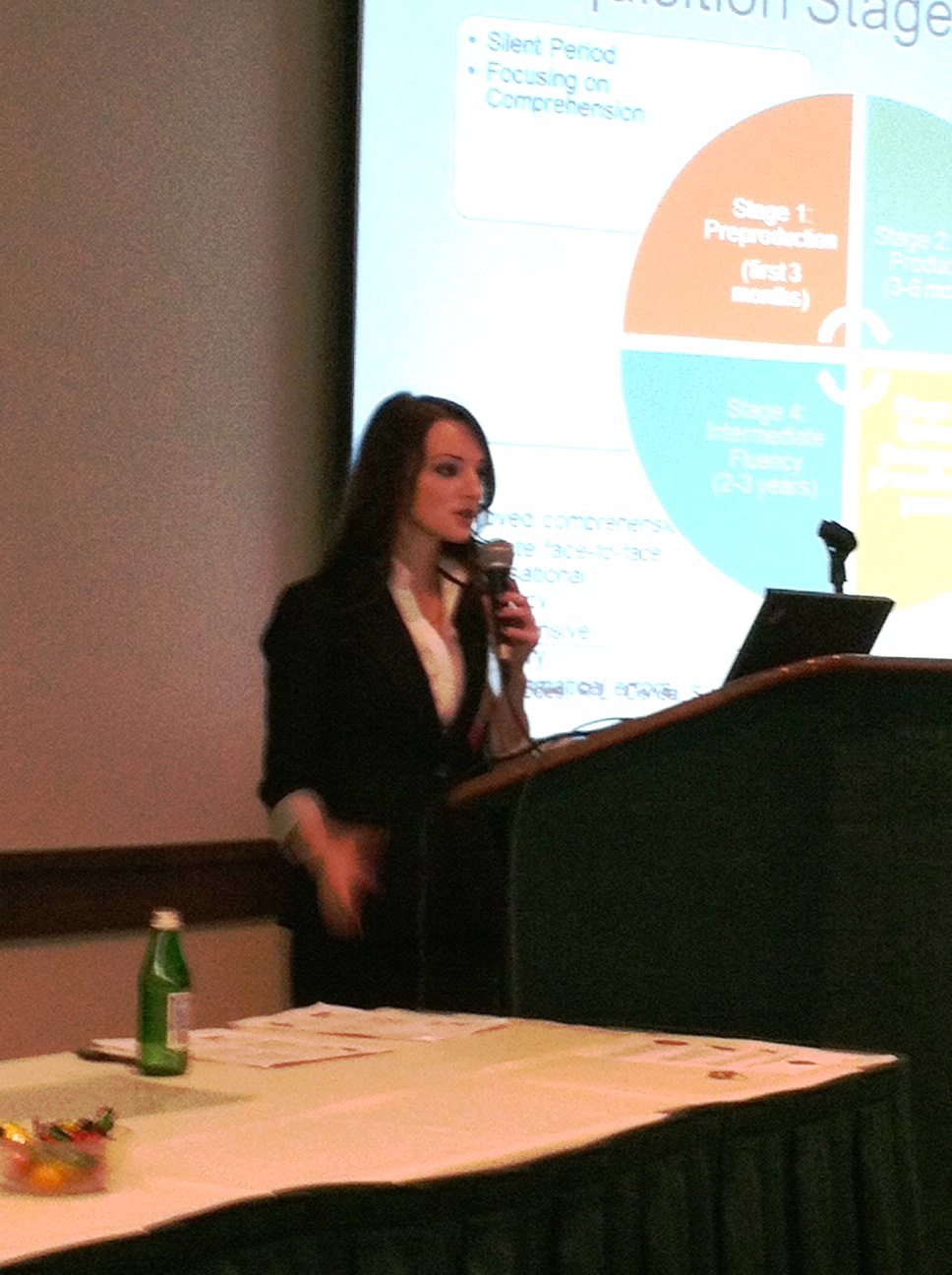
Student presenter (Natasha Borisov) at the 2013 NASP convention in Seattle, WA.
American Psychological Association
- Understanding Peer Victimization (August 2005)
- PREPaRE Crisis Prevention and Intervention Training (August 2007)
- Evaluation of the PREPaRE School Crisis Prevention and Intervention Traininig (August 2012)
International Association of School Psychologists
- School Crisis Intervention Using the PREPaRE Model (June 2015)
- Sharing School Psychology Practice Across Cultures and Continents (June 2015)
Other Seminars & Presentations
- Queens College Morning Session (January 2014)
- Queens College Afternoon Session (January 2014)
Publications
Refereed Journal Publications
- Brock, S. E., Rothbart, M. K., & Derryberry, D. (1986). Heart-rate deceleration and smiling in 3-month-old infants. Infant Behavior and Development, 9, 403-414. doi:10.1016/0163-6383(86)90014-7
- Sandoval, J., & Brock, S. E. (1996). The school psychologist's role in suicide prevention. School Psychology Quarterly, 11, 169-185. doi:10.1037/h0088927
- Brock, S. E., & Knapp, P. K. (1996). Reading comprehension abilities of children with attention-deficit/hyperactivity disorder. Journal of Attention Disorders, 1, 173-185. doi:10.1177/108705479600100305
- Brock, S. E. (1998). Helping classrooms cope with traumatic events. Professional School Counseling, 2, 110-116.
- Brock, S. E. (1999). The diagnosis of attention-deficit/hyperactivity disorder in childhood. The California School Psychologist, 4, 18-29. Retrieved from http://education.ucsb.edu/school-psychology/CSP-Journal/index.html
- Brock, S. E. (2000). Development of a school district crisis intervention policy. The California School Psychologist, 5, 53-64. Retrieved from http://education.ucsb.edu/school-psychology/CSP-Journal/index.html
- Brock, S. E., & Christo, C. (2003). Digit naming speed performance among children with attention-deficit/hyperactivity disorder. The California School Psychologist, 8, 115-125. Retrieved from http://education.ucsb.edu/school-psychology/CSP-Journal/index.html
- Bolnik, L., & Brock, S. E. (2005). The self-reported effects of crisis intervention work on school psychologists. The California School Psychologist, 10, 117-124. Retrieved from http://education.ucsb.edu/school-psychology/CSP-Journal/index.html
- Jimerson, S. R., Brock, S. E., & Pletcher, S. W. (2005). An integrated model of school crisis preparedness and intervention: A shared foundation to facilitate international crisis intervention. School Psychology International, 26, 275-296. doi:10.1177/0143034305055974
- Brock, S. E. (2006). An examination of the changing rates of autism in special education. The California School Psychologist, 11, 31-39. Retrieved from http://education.ucsb.edu/school-psychology/CSP-Journal/index.html
- Nickerson, A. B., Brock, S. E., & Reeves, M. A. (2006). School crisis teams within an incident command system. The California School Psychologist, 11, 63-72. Retrieved from http://www.caspsurveys.org/new/pdfs/journal06.pdf
- Brock, S. E., Nickerson, A. B., O’Malley, M. D., & Chang, Y. (2006). Understanding children victimized by their peers. Journal of School Violence, 5(3), 3-18. doi:10.1300/J202v05n03_02
- Nickerson, A. B., Brock, S. E., Chang, Y., & O’Malley, M. D. (2006). Responding to children victimized by their peers. Journal of School Violence, 5(3), 19-32. doi:10.1300/J202v05n03_03
- Brock, S. E., & Clinton, A. (2007). Diagnosis of attention-deficit/hyperactivity disorder (AD/HD) in childhood: A review of the literature. The California School Psychologist, 12, 73-91. Retrieved from http://www.csus.edu/indiv/b/brocks/Courses/EDS%20249/course%20outline.09.Spring/2009%20Readings/Brock%20&%20Clinton,%202007.pdf
- Nickerson, A. B., & Brock, S. E. (2011). Measurement and evaluation of school crisis prevention and intervention: Introduction to special issue. Journal of School violence, 10, 1-15. doi:10.1080/15388220.2010.519261
- Brock, S. E., Nickerson, A. B., Reeves, M. A., Savage, T. A., & Woitaszewski, S. A. (2011). Development, evaluation, and future directions of the PREPaRE School Crisis Prevention and Intervention Training Curriculum. Journal of School Violence 10, 34-52. doi:10.1080/15388220.2010.519268
- Saad, C., Brock, S. E., Ballard, Q., Yocum, L. C., Yates, C. B., & Wu, A. (2011). Using the PREPaRE model of school crisis prevention and intervention to respond to sudden and unexpected death. Greif Matters, 14, 12-17. Retrieved from http://www.grief.org.au/resources/grief_matters
- Nickerson, A. B., Serwacki, M. L., Brock, S. E., Savage, T. A., Woitaszewski, S. A., & Reeves, M. (2014). Program evaluation of the PREPaRE School Crisis Prevention and Intervention Training Curriculum. Psychology in the Schools, 51, 466-479. doi: 10.1002/pits.21757
- Brock, S. E., & Lourvar Reeves, M. A. (2018). School suicide risk assessment. Contemporary School Psychology, 22,174-185.doi: 10.1007/s40688-017-0157-7
- Louvar Reeves, M. A., & Brock, S. E. (2018). School behavioral threat assessment and management. Contemporary School Psychology, 22,148-162.doi: 10.1007/s40688-017-0158-6
- Brock, S. E., & Louvar Reeves, M. A. (2018). School-based threat assessment: Assessing the danger a student might present to self and others. Contemporary School Psychology, 22,105-108. doi:10.1007/s40688-018-0189-7
Books
 School Crisis Prevention and Intervention: The PREPaRE Model School Crisis Prevention and Intervention: The PREPaRE Model
Brock, S. E., Nickerson, A. B., Louvar Reeves, M.,Conolly, C., Jimerson, S. R., Pesce, R., & Lazzaro, B. (2016). School crisis prevention and intervention: The PREPaRE Model (2nd ed.). Bethesda, MD: National Association of School Psychologists.
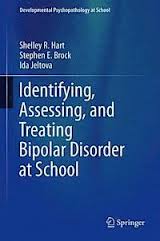 Identifying, Assessing, and Treating Bipolar disorder at School Identifying, Assessing, and Treating Bipolar disorder at School
Hart, S. R., Brock, S. E., & Jeltova, I. (2013). Identifying, assessing, and treating bipolar disorder at school. Bethesda, MD: National Association of School Psychologists.
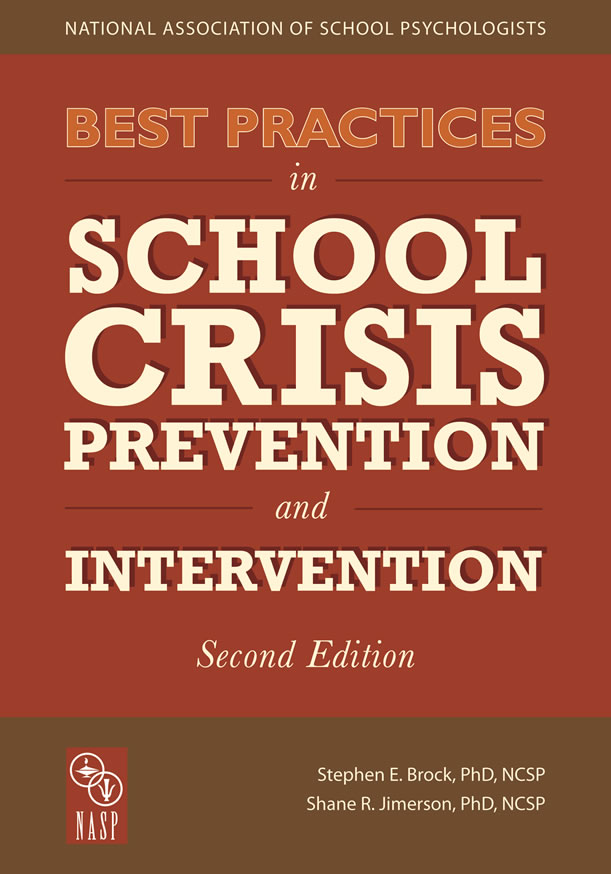 Best Practices in School Crisis Prevention and Intervnetion (2nd ed.) Best Practices in School Crisis Prevention and Intervnetion (2nd ed.)
Brock, S. E., & Jimerson, S. R. (Eds.). (2013). Best practices in school crisis prevention and intervention (2nd ed.). Bethesda, MD: National Association of School Psychologists.
 Identifying, Assessing, and Treating PTSD at School (Chinese Translation) Identifying, Assessing, and Treating PTSD at School (Chinese Translation)
Nickerson, A. B., Reeves, M. A., Brock, S. E., & Jimerson, S. R. (2012). 识别评估和治疗:中小学生创伤后应激障碍 [Identifying, assessing, and treating posttraumatic stress disorder at school]. (H. Tingting & X. Qian, Trans.). Beijing, China: China Light Industry Press/Beijing Multi-Million Electronic Graphics & Information. (Original work published in 2009).
 Identifying, Assessing, and Treating Self-Injury at School (Chinese Translation) Identifying, Assessing, and Treating Self-Injury at School (Chinese Translation)
Miller, D. N., & Brock, S. E. (2012). 识别评估和治疗:中小学生自伤问题 [Identifying, assessing, and treating self-injury at school] (T. Suquin & H. Zijuan, Trans.). Beijing, China: China Light Industry Press/Beijing Multi-Million Electronic Graphics & Information.
 Identifying, Assessing, and Treating ADHD at School (Chinese Translation) Identifying, Assessing, and Treating ADHD at School (Chinese Translation)
Brock, S. E., Jimerson, S. R., & Hansen, R. L. (2012). 识别评估和治疗:中小学生注意缺陷多动障碍 [Identifying, assessing, and treating attention-deficit/hyperactivity disorder at school]. (T. Chuan & S. Yu, Trans.). Beijing, China: China Light Industry Press/Beijing Multi-Million Electronic Graphics & Information.
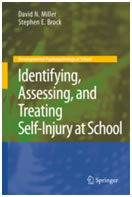 Identifying, Assessing, and Treating Self-Injury at School Identifying, Assessing, and Treating Self-Injury at School
Miller, D. N., & Brock, S. E. (2010). Identifying, assessing, and treating self-injury at school. New York: Springer
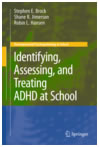 Identifying , Assessing, & Treating of ADHD at School Identifying , Assessing, & Treating of ADHD at School
Brock, S. E., Jimerson, S. R., & Hansen, R. (2009). Identifying, assessing, and treating ADHD at school. New York: Springer.
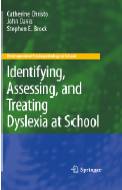 Identifying , Assessing, & Treating of Dyslexia at School Identifying , Assessing, & Treating of Dyslexia at School
Christo, C., Davis, J., & Brock, S. E. (2009). Identifying, assessing, and treating Dyslexia at school. New York: Springer.
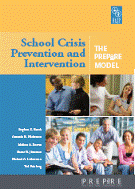 School Crisis Prevention and Intervention: The PREPaRE Model School Crisis Prevention and Intervention: The PREPaRE Model
Brock, S. E., Nickerson, A. B., Reeves, M. A., Jimerson, S. R., Lieberman, R., & Feinberg, T. (2009). School crisis prevention and intervention: The PREPaRE Model. Bethesda, MD: National Association of School Psychologists.
 Identifying , Assessing, & Treating of PTSD at School Identifying , Assessing, & Treating of PTSD at School
Nickerson, A. B., Reeves, M. A., Brock, S. E., & Jimerson, S. R. (2009). Identifying, assessing, and treating PTSD at school. New York: Springer.
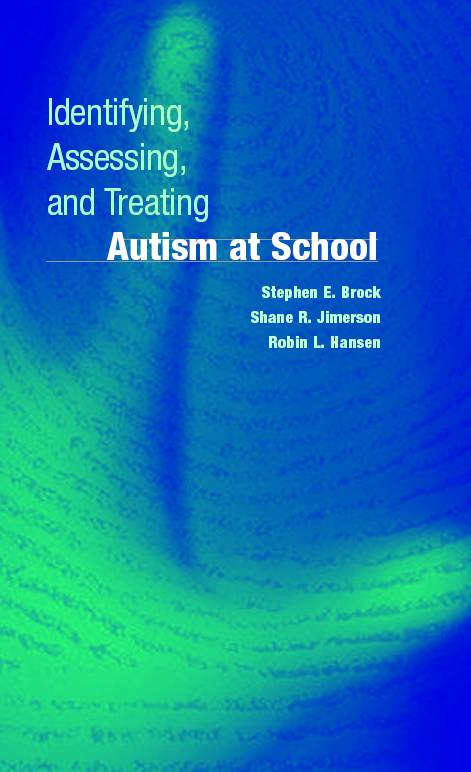 Identifying , Assessing, & Treating of Autism at School Identifying , Assessing, & Treating of Autism at School
Brock, S. E., Jimerson, S. R., & Hansen, R. L. (2006). Identifying, assessing, and treating autism at school. New York: Springer.
 Preparing for Crises in the Schools (Japanese Translation) Preparing for Crises in the Schools (Japanese Translation)
Brock, S. E., Sandoval, J., & Lewis, S. (2006). 学校心理学による問題対応マニュアル―学校で起きる事件・事故・災害にチームで備え、対処する [Preparing for crises in the schools: A manual for building school crisis response teams]. (R. Imada & Y. Yoshida, Trans.). Tokyo, Japan: Seishin Shobo.
 Crisis Management at School (Greek Translation) Crisis Management at School (Greek Translation)
Brock, S. E., Sandoval, J., & Lewis, S. (2005). Διαχείριση κρίσεων στο σχολείο: Εγχειρίδιο για τη δημιουργία ομάδων διαχείρισης κρίσεων στο σχολείο [ Preparing for crises in the schools: A manual for building school crisis response teams] (2 nd ed., C. Hatzichristo Ed., E. Theoharakis, Trans.). Athens, Greece: Tipothito.
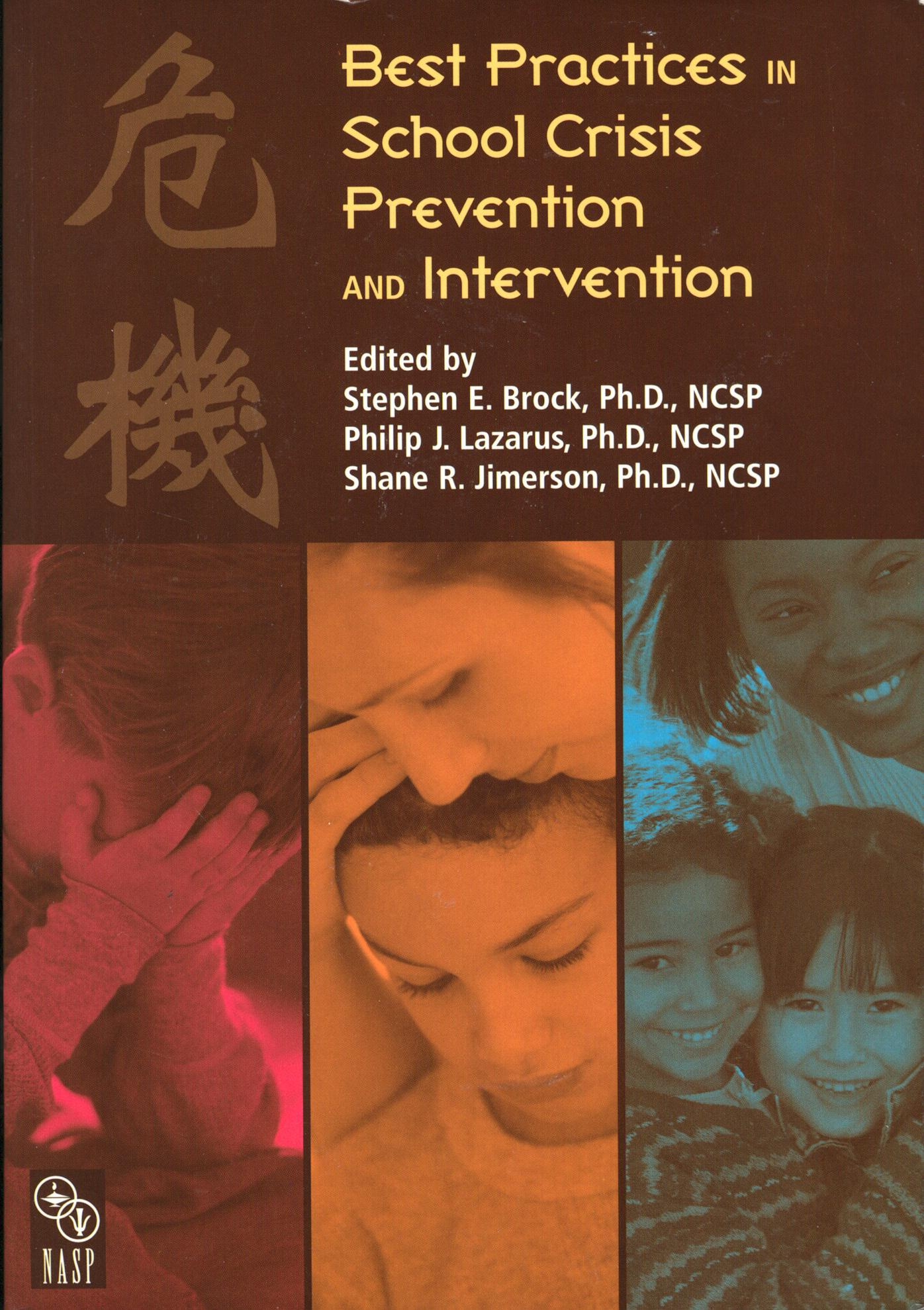 Best Practices in School Crisis Prevention and Intervention Best Practices in School Crisis Prevention and Intervention
Brock, S. E., Lazarus, P. J., & Jimerson, S. R. (Eds.). (2002). Best practices in school crisis prevention and intervention. Bethesda, MD: National Association of School Psychologists.
 Preparing for Crises in the Schools (2nd ed.) Preparing for Crises in the Schools (2nd ed.)
Brock, S. E., Sandoval, J., & Lewis, S. (2001). Preparing for crises in the schools: A manual for building school crisis response teams (2 nd ed.). New York: Wiley.
 Preparing for Crises in the Schools Preparing for Crises in the Schools
Brock, S. E., Sandoval, J., & Lewis, S. (1996). Preparing for crises in the schools: A manual for building school crisis response teams. Brandon, Vt: CPPC
Recent Book Chapters
- Reeves, M. A., Nickerson, A. B., & Brock, S. E. (2011). Preventing and intervening in crisis situations. In T. M. Lionetti, E. Snyder, & R. W. Christner (Eds.). A practical guide to developing competencies in school psychology (pp. 193-208). New York, NY: Springer.
- Brock, S. B., Jimerson, S. R., Hart, S. R., & Nickerson, A. B. (2012). Preventing, preparing for, and responding to school violence with the PREPaRE Model. In S. R., Jimerson, A. B., Nickerson, M. J., Mayer, & M. J., Furlong (Eds.), Handbook of school violence and school safety: International research and practice (2nd ed., pp. 463-474). New York, NY: Routledge.
- Brock, S. E., & Jimerson (2012). Progress and future directions in school crisis prevention and intervention. In S. E. Brock & S. R. Jimerson (Eds.) Best practices in school crisis prevention and intervention (2nd ed.; pp. 3-8). Bethesda, MD: National Association of School Psychologists.
- Reeves, M. A., Conolly-Wilson, C. N., Pesce, R. C., Lazzaro, B. R., & Brock, S. E. (2012). Preparing for comprehensive school crisis response. In S. E. Brock & S. R. Jimerson (Eds.) Best practices in school crisis prevention and intervention (2nd ed.; pp. 245-264). Bethesda, MD: National Association of School Psychologists.
- Brock, S. E. (2012). Preparing for school crisis intervention. In S. E. Brock & S. R. Jimerson (Eds.) Best practices in school crisis prevention and intervention (2nd ed.; pp. 265-283). Bethesda, MD: National Association of School Psychologists.
- Flitsch, E., Magnesi, J., & Brock, S. E. (2012). Social media and crisis intervention. In S. E. Brock & S. R. Jimerson (Eds.) Best practices in school crisis prevention and intervention (2nd ed.; pp. 287-304). Bethesda, MD: National Association of School Psychologists.
- Reeves, M. A., Conolly-Wilson, C. N., Pesce, R. C., Lazzaro, B. R., Nickerson, A. B., Feinberg, T., . . . Brock, S. E. (2012). Providing the comprehensive school crisis response. In S. E. Brock & S. R. Jimerson (Eds.) Best practices in school crisis prevention and intervention (2nd ed.; pp. 305-316). Bethesda, MD: National Association of School Psychologists.
- Brock, S. E. (2012). Economic crises. In S. E. Brock & S. R. Jimerson (Eds.) Best practices in school crisis prevention and intervention (2nd ed.; pp. 561-572). Bethesda, MD: National Association of School Psychologists.
- Jimerson, S. R., & Brock, S. E. (2012). Reflections on prevention, intervention, and future directions. In S. E. Brock & S. R. Jimerson (Eds.) Best practices in school crisis prevention and intervention (2nd ed ; pp. 731-733). Bethesda, MD: National Association of School Psychologists.
- Jimerson, S. R., Brock, S. E., & Brown, J. A. (2013). Immediate school-based interventions following violent crises. In C. Franklin, M. B. Harris, & P. Allen-Meares (Eds.), The school services sourcebook: A guide for school-based professionals (2nd ed., pp. 579-589). New York, NY: Oxford University Press.
- Brock, S. E. (2013). Preparing for the school crisis response. In J. Sandoval (Ed.), Handbook of crisis counseling, intervention and prevention in the schools (3rd ed., pp. 19-30). New York, NY: Routledge.
- Sandoval, J., Brock, S. E., & Knifton, K. (2013). Acts of violence. In J. Sandoval (Ed.), Handbook of crisis counseling, intervention and prevention in the schools (3rd ed., pp. 212-228). New York, NY: Routledge.
- Brock, S. E., Ballard, Q., & Saad, C. (2013). Preparing for and responding to disasters. In J. Sandoval (Ed.), Handbook of crisis counseling, intervention and prevention in the schools (3rd ed., pp. 229-241). New York, NY: Routledge.
- Brock, S. E., Holly, E., Sisson, H., & Ybarra, L. A. (2013, November). Medical model perspectives on autism. In H. Montgomery (Ed.), Oxford Bibliographies in Childhood Studies. New York: Oxford University Press. Retrieved from http://www.oxfordbibliographies.com
- Brock, S. E., Reeves, M. A. L., & Nickerson, A. B. (2014). Best practices in school crisis intervention. In P. Harrison & A. Thomas (Eds.), Best practices in school psychology: System level services (pp. 211-230). Bethesda, MD: National Association of School Psychologists.
- Brock, S. E., & Jimerson, S. R. (2017). School crisis consultation: An international framework. In C. Hatzichristou & S. Rosenfield (Eds.) The international handbook of consultation in educational settings(pp. 198-213). New York, NY: Taylor & Francis.
- Reeves, M. A. L., & Brock, S. E. (in press). Responding to students who threaten violence: Helping handout for the school. In K. Minke (Ed.). Helping handouts: Supporting students at school and home. Bethesda, MD: National Association of School Psychologists.
- Brock, S. E., & Reeves, M. A. L. (in press). Suicidal thinking and threats: Helping handout for the home. In K. Minke (Ed.). Helping handouts: Supporting students at school and home. Bethesda, MD: National Association of School Psychologists.
- Brock, S. E., & Reeves, M. A. L. (in press). Suicidal thinking and threats: Helping handout for the school. In K. Minke (Ed.). Helping handouts: Supporting students at school and home. Bethesda, MD: National Association of School Psychologists.
- Reeves, M. A. L., & Brock, S. E. (in press). Trauma exposure: A handout for the home. In K. Minke (Ed.). Helping handouts: Supporting students at school and home. Bethesda, MD: National Association of School Psychologists.
- Reeves, M. A. L., & Brock, S. E. (in press). Trauma exposure: Helping handout for the school. In K. Minke (Ed.). Helping handouts: Supporting students at school and home. Bethesda, MD: National Association of School Psychologists.
Psychology Internship/Fieldwork
Fieldwork placements will be assigned by CSUS school psychology faculty.
Students are expected to independently find their internship placements.
It is anticipated that most school psychology internship placements will be within a 50 mile radius of the CSUS campus. Students who wish to consider internships outside of this area will need to obtain the approval of the school psychology faculty.
Internship Forms
Fieldwork Forms
|
 california state university, sacramento
 Stephen E. Brock, Ph.D., NCSP, LEP