Story Content
Interactive Belonging Maps highlight resources for diverse communities on campus and in the Sacramento region
December 09, 2025
Sacramento State is putting belonging on the map — virtually.
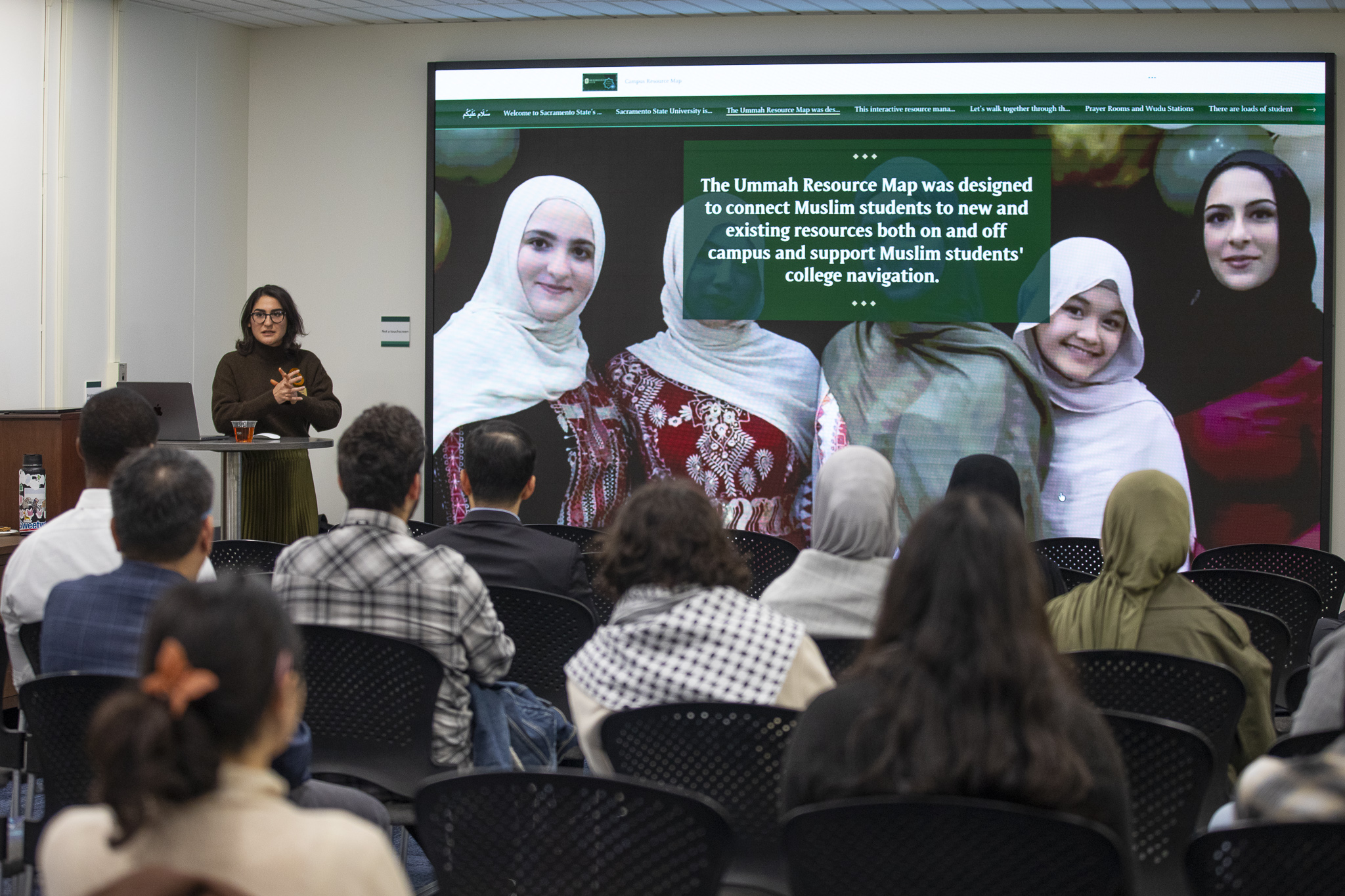
The Geography Department and Office of Inclusive Excellence recently launched the Belonging Maps project, a series of online, interactive maps to connect Hornets with campus spaces, organizations, and services as well as local businesses, cultural centers, and community resources that reflect Sacramento’s rich diversity.
The multimedia platform uses photos, videos, and vibrant graphics to make the maps as interactive as they are informative in a way that is fun and accessible for students.
“Ultimately, it’s about belonging,” Vice President of Inclusive Excellence Michael Nguyen said. “We want students to feel seen, supported, and connected to Sac State. This is the tool that will help our students navigate their time here and give them a much better experience.”
The project started last year when Geography professor Hanieh Molana, faculty advisor for the Muslim Student Association, was talking to students about University resources that met their religious needs.
“The number of Muslim students on campus is growing,” Molana said. “We talked about how cool it would be to have something that showed what resources we have for them, a map of campus where they could find halal food, where they could go for prayer, and what student organizations we have.
“It’s crazy how many resources we have, but students don’t know about them.”
With support from the Office of Inclusive Excellence, Molana and student intern Ian Michael Brown began talking with University and community leaders to collect data for the Ummah campus resource map.
The idea quickly expanded to other communities, and soon they were also working with Hispanic Serving Institution Director Lilia Contreras Ramirez on a similar map for the Latine community.
Somos, which means “we are” in Spanish, was the first Belonging Map to launch earlier this fall, followed by Ummah in November.
“Students felt like there was not enough awareness of the resources, or they didn’t know some of the resources existed until they were ready to graduate,” Ramirez said. “A lot of the resources are in different divisions or different departments.
“We thought it would be amazing if we had a one stop shop.”
Ramirez connected with Molana, and they took the Belonging Maps even further.
“Students don’t just come to Sac State, they come to the Sacramento region,” Ramirez said. “There are resources and services that they need outside of their student identity. They need to build a home and a community in Sacramento.”
So, each campus resource map also has a complementary map of the Sacramento region, pinpointing area businesses, religious sites, community centers, organizations, services, and more.
“Students don’t just come to Sac State, they come to the Sacramento region. There are resources and services that they need outside of their student identity. They need to build a home and a community in Sacramento.” -- Hispanic Serving Institution Director Lilia Contreras Ramirez
Maps for other communities are in the works as well. Ubuntu, a map for the Black community, will have a soft launch in February.
“The goal is to make sure students know when they come to Sac State they are supported,” Molana said. “Regardless of whether they come from Sacramento or L.A., we’ve got their backs. We have resources on campus and off campus for them.
“They can take a look at this map and find out where the closest mosque, or church, or panaderia, or halal market is without wandering the city.”
Ramirez took Brown on what she affectionately called “hood rides” along Franklin and Stockton boulevards, where they talked to business owners, sampled street food, and snapped photos of colorful murals that told the history of Sacramento’s Latine community.
“As we were collecting information, we realized that a lot of the businesses have these beautiful murals on their walls,” Ramirez said. “We looked into the history of Latinos in Sacramento and they were heavily connected to the Chicano movement, activism, and culture.
“We pinned all these murals, and we were amazed at how a lot of them were contemporary, and also replicas of art pieces from the Royal Chicano Air Force, which was a huge movement. So, we were learning about this new group of artists.”
The maps also address students’ various identities whether they’re parents, multiracial, religious or not and includes features such as bilingual schools, food banks, shelters, barbershops, hair salons and food.
Brown, a Geography student who graduates this winter, said the maps go beyond locating physical places, they pinpoint sites based on specific qualities.
“It’s really highlighting information that isn’t necessarily something that can be put into a number, and that is an area I feel is just being touched,” Brown said. “This project took different groups that inhabit the Sacramento area and highlighted resources in a way that Google maps wouldn’t be able to do.
“It gave me real job experience, but also allowed me to do something that makes a difference.”
The Belonging Maps team felt it was important to create something that was easy to use and engaging to students. Oftentimes information about the services and resources on campus are buried on website pages that can be difficult to find.
“We wanted it to be simple and easy to use, and we want community members to use this as well,” Molana said.
Nguyen also wants to expand the project beyond Sacramento.
“The goal is to create this for every single CSU campus, so it becomes a system-wide and statewide resource,” he said.
The Belonging Maps continue to evolve.
Members of the public can add places to the community maps by clicking a button and filling out basic information. Once it’s been verified, the site will be added.
There’s even the possibility of developing a Belonging Maps app.
“I felt like this was missing, not only in the Muslim community but for our students as well,” said Molana, who studies postwar societies and decolonization. “... When you think about it, supporting the community itself should be part of any scholarship, especially for a public university.
“Our students are everything to us.”
Media Resources
Faculty/Staff Resources
Looking for a Faculty Expert?
Contact University Communications
(916) 217-8366
communications@csus.edu