Story Content
Sac State celebrates Earth Day
April 22, 2026
Earth Day at Sacramento State will crackle with electricity this year thanks to more than $1.8 million in grants.
The Office of Sustainability’s annual Earth Day Community Fair, scheduled for 10 a.m. to 2 p.m. on April 22 in the Main Quad, will include an e-waste collection, campus and community information tables, games, and music.
This year, a brand-new, electric-powered Hornet Shuttle will also be on display in the quad, and it’s just one of several new, grant-funded projects aimed at transitioning California drivers to clean, zero-emission electric vehicles.
“California is pushing hard to improve the electric vehicle charging infrastructure statewide, so we’re seeing a lot more grants available,” Director of Energy & Sustainability Ryan Todd said. “We don’t have the money to put in this infrastructure or buy electric shuttles, so we’re leveraging grants.
“It’s an obvious benefit to our campus as well as to the community.”
The first Earth Day, held in 1970, helped spark the modern environmental movement and led to the creation of the Environmental Protection Agency.
Hornets have much to celebrate this year.
Sacramento State recently earned the Clean California Community designation, part of Governor Gavin Newsom’s Clean California initiative.
In addition, Sac State Sustainability and University Transportation and Parking Services (UTAPS) worked together to pursue funding for electric vehicle and infrastructure funding as well as other projects to reduce the campus’s environmental impact.
Since then, Sac State has won more than $1.8 million in grants, including:
- $1 million from the California Energy Commission through the Sacramento Municipal Utility District to construct six fast-charging electric vehicle stations in Parking Lot 9
- $384,000 from the Volkswagen Environmental Mitigation Trust to purchase two electric-powered shuttles
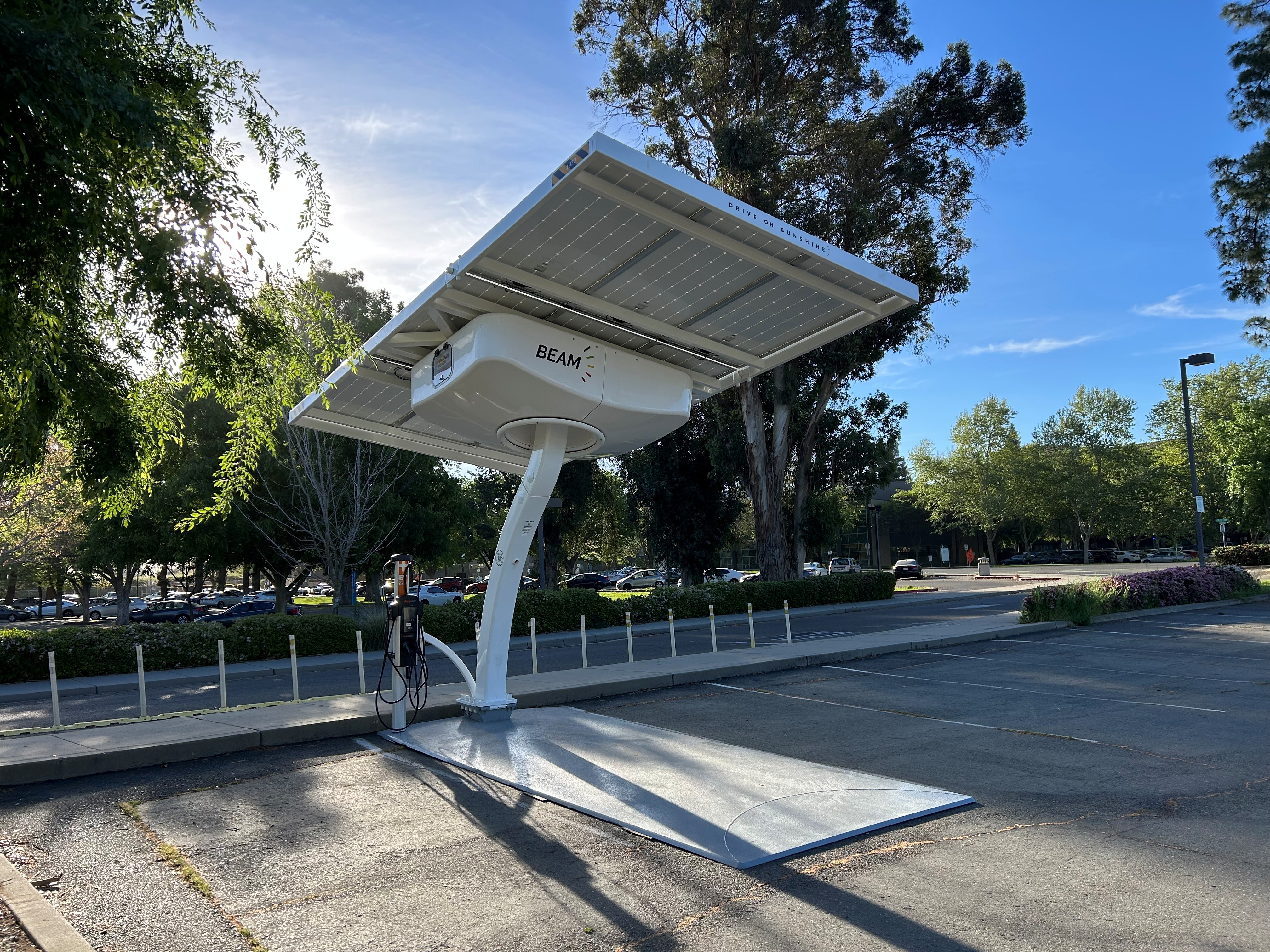
- $255,000 from the Sacramento Municipal Air Quality Management District for three solar-powered electric vehicle charging stations at Folsom Hall, the Alumni Center, and Parking Lot 11
- $222,000 from CalRecycle for 37 water bottle filling stations
The new charging stations are available for the public to use.
“California wants to transition to more electric vehicles, but the biggest challenge is having the charging infrastructure,” Todd said. “Gas stations are on every street corner and have been around for a hundred years or so.
“But if California wants people to buy more EVs, charging them needs to be as easy as going to a gas station.”
Sac State’s location off Highway 50 makes it an ideal spot for EV stations, especially the fast-chargers.
“It’s a main thoroughfare, so people can pop off the freeway like they would for gas and hang out for 20 minutes to fully charge, then pop back on the freeway and be on their way,” Todd said.
The fast-charging stations will also be used to power two new EV shuttles that are part of the Hornet Line, the free campus transit system.
The loop route connects all of the campus buildings with Regional Transit’s 65th Street station as well as Folsom Hall, North Village, and Hornet Commons, making it easier for faculty, staff, and students to use public transportation to commute to Sac State.
“It helps with emissions and congestion and also helps reduce the demand on parking by providing these alternatives,” UTAPS Director Jeff Dierking.
Hornet Shuttle’s fleet of five vehicles also includes three fueled by Compressed Natural Gas, a cleaner alternative to gasoline.
It currently takes 12 to 16 hours to fully charge an EV shuttle using the existing stations on campus. One charge is almost enough to complete one day’s entire route, roughly 160 miles, Dierking said.
“Moving to all electric vehicles is going to help us be more sustainable for the future and also allow us to fuel on site and keep our routes moving here on campus,” he said.
Drivers are still getting used to the new vehicles.
“The other buses are quite loud, and these are very, very quiet,” Dierking said.
Construction on the fast-charging stations is set to begin in mid-May.
Three solar-powered stations by Beam Global are already in operation. Considered Level II chargers, they’re faster than plugging a car into a typical 120-volt household outlet but slower than Level III fast-chargers.
“It’s entirely off the grid, there’s no infrastructure,” Todd said. “We just dropped them in place, and they’re powered by the sun.”
New water bottle-filling stations are currently being installed throughout the campus, including some outdoor locations, said Waste & Sustainability Analyst Laura Gonzalez-Ospina.
“Water bottle filling stations help reduce the number of plastic water bottles people buy that end up in the landfill,” Todd said, adding that installations will continue through August.
Media Resources
Faculty/Staff Resources
Looking for a Faculty Expert?
Contact University Communications
(916) 217-8366
communications@csus.edu